Ventilation & Exhaust
Range hood, bathroom fan and dryer venting — code-correct exterior termination, not into the attic.
An HRV — what most Nova Scotia homeowners call an air exchanger — brings fresh air into a tight house without throwing away the heat you've paid for. We install, replace and properly duct HRV and ERV systems across HRM, sized for this climate and balanced so they actually deliver.
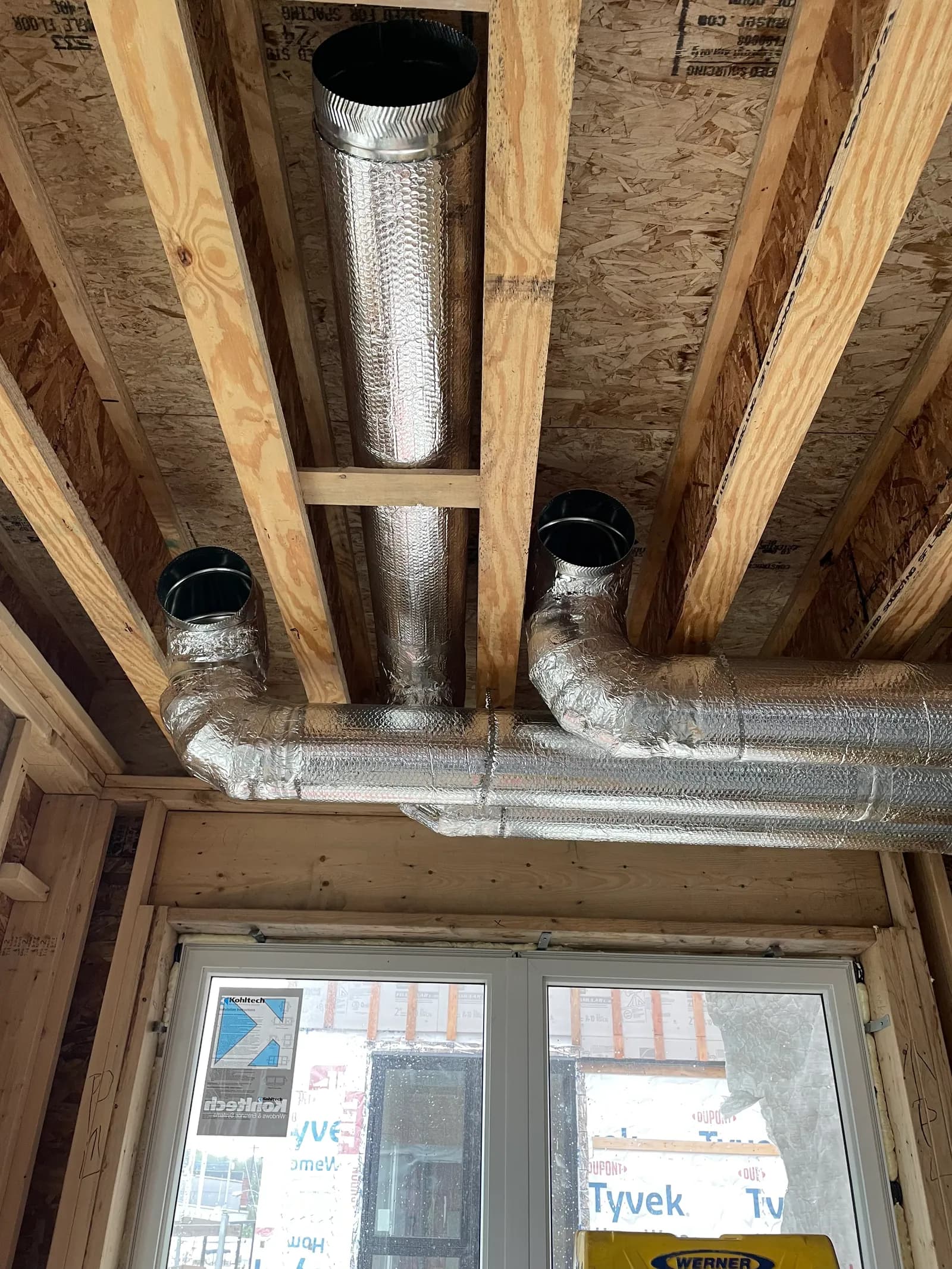
Whether an HRV or an ERV is right for your home depends on how it's built and heated — not on a brochure. We size the choice to the house, then duct it properly so it actually delivers fresh air to the rooms that need it. If yours has quit, we'll check the cheap causes first: a lot of air exchangers written off as dead are a clogged filter, a fouled core, a seized damper, or a unit that was never balanced after install. When it genuinely is past saving, we replace it and fix whatever the original ducting got wrong.
Usually, in everyday speech — "air exchanger" is what most Nova Scotia homeowners call it, and in newer homes the unit is most often an HRV (heat recovery ventilator). Strictly, though, Efficiency Nova Scotia treats a basic air exchanger as a separate type that swaps the air without recovering its heat. An HRV recovers the heat; an ERV also moves moisture. If your old unit has no heat-recovery core, replacing it with an HRV is an upgrade.
It depends on your home, not a rule of thumb. An HRV recovers heat and helps dump excess winter moisture, so it suits homes that fog up windows or feel damp — often older or higher-occupancy ones. An ERV also moves some humidity, which keeps a tight, well-sealed home from getting too dry in winter and eases summer stickiness — which is why tightly built modern homes increasingly choose one. We size the choice to how your house actually behaves, not a brochure.
Check the cheap things first. Plenty of units that seem dead are a blocked filter, a dirty core, an iced-up intake, a seized damper motor, or controls that were never set up properly — service work, not a new machine. Replacement makes sense when the motor or core has actually failed on a unit that's already past its lifespan. We'll tell you which one you're looking at before quoting anything.
Commonly quoted at 10–15 years, and a good unit that's had its filters and core cleaned regularly can run 20. Ones that were never serviced tend to go early — usually the motor or the damper first. If yours is past 15 years and struggling, replacement is usually the honest answer.
As a planning figure, a straight swap where the existing ducting is sound is typically the cheapest path, while a first-time installation that needs new dedicated ducting runs considerably more — Canadian figures for a fully installed system generally land somewhere in the $2,500–$5,000 range, higher for large or complex homes. That's an estimate, not a quote: the unit, the state of the ducting and how much of it has to be rebuilt decide the real number. We price it after seeing what's there.
A properly ducted HRV/ERV pulls stale, damp air from bathrooms and the kitchen area and delivers fresh air to living spaces and bedrooms — balanced so it works, not just installed. A lot of the underperforming units we open up were ducted to the wrong rooms or never balanced at all.
Tell us what's happening and share a few photos — we'll get you a practical quote.
Request a Quote