Does a Range Hood Have to Vent Outside in Nova Scotia? What the Building Code Says
In a new house in Nova Scotia, effectively yes. The National Building Code of Canada 2020, which Nova Scotia uses without changing these clauses, requires every kitchen to have an exhaust fan rated at no less than 50 litres per second, about 106 CFM, and requires the ductwork for a cooking appliance exhaust fan to lead directly to the outdoors. A recirculating hood sends the air back into the kitchen, so on our reading it does not meet the requirement on its own. The code does not insist on a hood: the kitchen fan can also be a ceiling or wall fan, or the home's principal ventilation fan in two specific arrangements. An existing house does not have to be brought up to the current code unless it is unsafe or the work falls under a permit, but Health Canada and Natural Resources Canada both say a gas range should have a hood that vents outdoors.
Search whether a range hood has to vent outside and you'll be told no. Google's summary says so. Hood sellers say so, and one of the pages ranking for it quotes a US code to prove it. A 2018 forum answer says a hood "doesn't have to be vented."
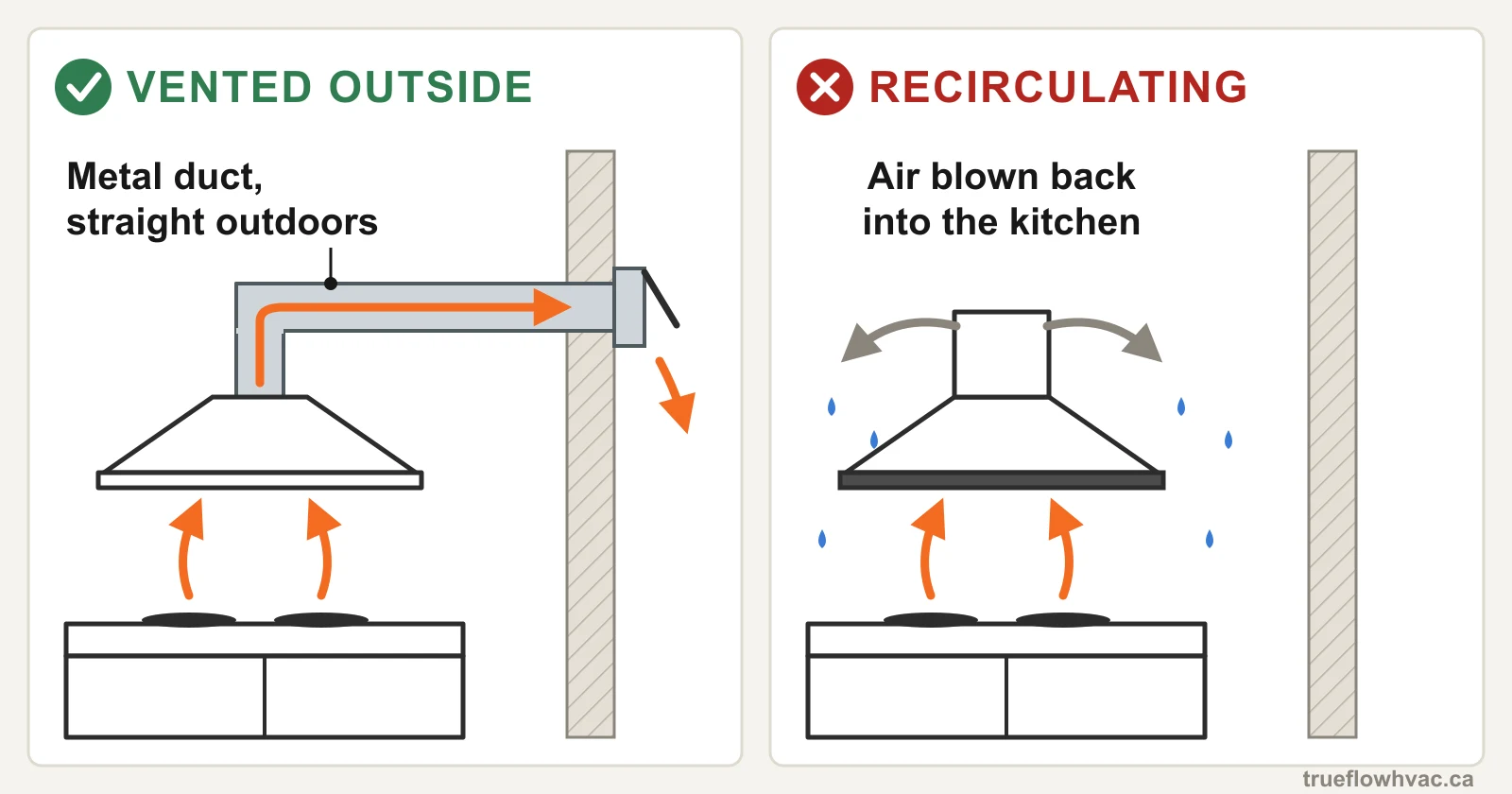
For a new house in Nova Scotia, that's the wrong answer. We read the code Nova Scotia actually uses, the National Building Code of Canada 2020. It doesn't use the words "range hood" in its requirement, but it requires an exhaust fan in every kitchen, and it says the duct from a cooking exhaust fan has to lead directly to the outdoors. A recirculating hood doesn't do either.
Below is what the code says, clause by clause, and what changes for a gas range, a house with an HRV, a renovation and the older house most of Halifax lives in. Where the answer turns on something we couldn't read ourselves, we say so.
The short answer
Nova Scotia adopted the National Building Code of Canada 2020 from 1 April 2025. The province's Building Code Regulations change two things in the ventilation section, the principal ventilation rule and exhaust-only systems, and leave the kitchen exhaust and duct clauses alone. So the national text applies as written.
| Your situation | Does the kitchen need outdoor exhaust? | What decides it |
|---|---|---|
| New house | Yes: a kitchen exhaust fan of at least 50 L/s | Supplemental exhaust, 9.32.3.7.(1) |
| New house, recirculating hood only | Doesn't meet it on its own, on our reading | Cooking exhaust duct must lead directly outdoors, 9.32.3.11.(6) |
| New house, HRV exhaust in the kitchen | Maybe not a separate fan, in two arrangements | 9.32.3.7.(2) and (3) |
| Gas or propane range | Health Canada and NRCan say vent it outside | Health guidance; the gas code itself is a separate CSA standard |
| Renovation under a permit | The building official decides what the current code applies to | Permit scope |
| Existing house, no permit work | The code isn't applied retroactively | Nova Scotia regulations, section 7(1) |
The rest of this page shows where each line comes from.
What the code actually says
The kitchen rule is Article 9.32.3.7, Supplemental Exhaust:
"Except as provided in Sentences (2) and (3), a supplemental exhaust fan with a rated capacity not less than 50 L/s shall be installed in each kitchen." (9.32.3.7.(1))
50 litres per second is about 106 CFM. That's a modest fan: the code sets a floor, not a target. For sizing a hood to your cooking, see our range hood installation guide.
The code's explanatory notes say what a supplemental exhaust fan is for. The kitchen needs "a certain amount of exhaust... to capture pollutants at the source" (Note A-9.32.3.7.), and "supplemental exhaust fans, such as kitchen cooktop hoods and bathroom fans, provide more ventilation at point of source when needed" (Note A-9.32.3.3.).
The same article sets two practical rules:
- A switch in the kitchen. The fan "shall be controlled by a manual switch located in the room served by the fan" (9.32.3.7.(6)). If it also has an automatic control, the manual switch has to turn it on regardless (9.32.3.7.(8)).
- High up, if it isn't over the stove. A kitchen exhaust fan "other than a cooking appliance exhaust fan serving a cooktop" goes "in the ceiling or on the wall at not less than 2 m above the floor" (9.32.3.7.(5)).
So the code doesn't strictly require a range hood. It requires a kitchen exhaust fan. A hood over the cooktop is the usual way to provide it, and the one that captures cooking pollutants best, but a ceiling or high-wall fan also meets the article.
Why a recirculating hood doesn't count
A recirculating (ductless) hood pulls air through a grease filter and a charcoal filter and blows it back into the kitchen. Two clauses in the code's duct article, 9.32.3.11, are why it can't be the kitchen's required exhaust fan:
- "Exhaust ducts shall not discharge into heated or unheated enclosed spaces." (9.32.3.11.(2))
- "Ductwork for cooking appliance exhaust fans shall (a) be of noncombustible, corrosion-resistant material, (b) lead directly to the outdoors with no connections to other exhaust fans or ducts, and (c) be equipped with a grease filter at the intake end." (9.32.3.11.(6))
The code requires an exhaust fan, and the duct from a cooking exhaust fan has to lead directly to the outdoors. A hood that returns the air to the room exhausts nothing. That's our reading of the plain wording, and it's the building official who applies it, but we found nothing in the article or its notes that treats recirculation as exhaust.
It isn't only a code point. Natural Resources Canada puts it plainly in its guidance on combustion gases: "Recirculating range hoods do not remove combustion products." A charcoal filter catches some grease and odour. The steam, heat and any combustion gases go back into the kitchen. In a Halifax house in winter, that steam ends up on the windows, and we cover what it does over time in range hood venting mistakes.
Your HRV can stand in for the kitchen fan, in two cases
Most new Nova Scotia houses have a principal ventilation system, often an HRV. The code lets it replace the separate kitchen fan in two arrangements, and only those two:
- Its only exhaust intake is in the kitchen. Then a supplemental fan "is not required" (9.32.3.7.(2)).
- It draws from the kitchen and other rooms, with a boost. The fan has to switch to "a high exhaust rate equal to not less than 2.5 times the minimum normal operating exhaust capacity," turned on by "a manual switch in the kitchen labeled 'KITCHEN EXHAUST'" (9.32.3.7.(3)).
The code's note spells out the gap these two cases close. When the principal fan draws from several rooms, "there will not be enough exhaust from the kitchen," so a separate kitchen fan is required unless the rate can be boosted (Note A-9.32.3.7.). An HRV exhaust grille in the kitchen ceiling isn't by itself a substitute for a hood.
Efficiency Nova Scotia's guide to ventilation for new homes recommends the hood anyway: "New homes should have a kitchen range hood that exhausts directly outside." It also warns against the shortcut people sometimes ask us about: "Because cooking grease could clog the system's core, the ventilation system shouldn't be connected directly to a kitchen range hood and the kitchen exhaust shouldn't be located close to the stove." The code says something similar. Any exhaust intake within 3 m horizontally of a cooktop needs a grease filter at the intake (9.32.3.11.(5)), and an HRV's exhaust grille in a kitchen has to be in the ceiling or on the wall at least 2 m up (9.32.3.3.(10)).
Keep the hood and the HRV separate. The hood goes straight outside on its own duct. The HRV does the house's continuous ventilation. Our guide to whether an HRV is required in Nova Scotia covers the rest of the ventilation code.
Gas and propane ranges
This is where outdoor venting matters most, and the Canadian health guidance is unanimous:
- Health Canada, on nitrogen dioxide: "Make sure that gas stoves have a range hood fan that vents to the outside. This is important to use while cooking."
- Natural Resources Canada, on combustion gases: if you have an unvented gas range, "be sure to use your outdoor vented range hood, and provide extra ventilation whenever the appliance is operating."
- Health Canada's factsheet on cooking and indoor air quality says a range hood exhaust fan reduces "PM, NO2, CO, and water vapour," and that running one on high, about 300 CFM, during cooking "can reduce exposure to cooking-related pollutants by more than 80% when compared to slower speeds." It also recommends the hood "fully extend over the stove burners."
Use it on high, and use the back burners. Health Canada's nitrogen dioxide page recommends cooking on the back burner of a gas stove because it "helps direct nitrogen dioxide and other gasses to the exhaust fan."
The installation rules for gas and propane appliances are in a separate CSA gas code, not the building code. It's a paid standard and we haven't read it, so we won't tell you what it says about your range. One Halifax ventilation company states that Nova Scotia's gas codes require a power-vented hood before a new range is connected. We couldn't verify that against the standard, so ask your gas fitter before the range goes in.
A strong hood in a house with an oil furnace on a chimney raises a separate question, make-up air. That's covered in our range hood make-up air guide.
What the duct has to be
Venting outside is half the job. The code is specific about the duct:
| The code asks for | What it means in your kitchen | Where |
|---|---|---|
| Noncombustible, corrosion-resistant duct | Metal, not plastic or foil flex | 9.32.3.11.(6)(a) |
| Directly to the outdoors, no connections to other fans or ducts | Its own duct and its own exterior cap. Not tied into the bathroom fan or the dryer vent | 9.32.3.11.(6)(b) |
| Grease filter at the intake | The hood's filter is part of the requirement, so keep it clean | 9.32.3.11.(6)(c) |
| Never into an enclosed space | Not into the attic, a closed soffit or the space between joists | 9.32.3.11.(2) |
| Insulated to RSI 0.5 through unheated space | A run through a cold attic or garage is wrapped, or the warm, moist air condenses in it | 9.32.3.11.(3) |
| Joints sealed with mastic, metal foil tape or the maker's sealant | Not cloth duct tape | 9.32.3.11.(8) |
| Supported, not crushed or sagging | No dips where grease and condensation collect | 9.32.3.11.(7) |
| Quiet enough | A kitchen fan with less than 1 m of duct to the room is limited to 2.5 sones (CSA rating) or 3.5 (HVI rating) | 9.32.3.10.(6), Table 9.32.3.10.-B |
The "no connections" rule catches a common renovation shortcut: teeing the new hood into a nearby bathroom fan duct to avoid a second hole in the wall. The code doesn't allow it.
Older houses, renovations and rentals
The code isn't applied to an existing house just because it exists. Nova Scotia's Building Code Regulations say construction that lawfully existed before them "is not required to conform" to them "if the construction or condition does not constitute an unsafe condition in the opinion of a building official" (section 7(1)). A 1970s kitchen with a recirculating hood isn't illegal.
New work is different, and whether a hood counts as new work is a question for HRM. The municipality's home improvement permit page says a permit is needed when a renovation "includes changes to interior or exterior walls," and lists replacing cabinets among the work that doesn't. A new hood with a new hole through the outside wall sits between the two. A kitchen renovation that opens walls is plainly on the permit side, and then the building official decides what the current code applies to. Ask HRM before you start.
Condos and apartment buildings are a different case. The rules on this page are for a home with its own ventilation system. In a larger building, the ventilation is designed for the building, and a new opening in an exterior wall is usually the condo corporation's or the landlord's decision.
The physics doesn't wait for a permit. Whatever the code requires of your house, the health advice above applies to the kitchen you cook in now. If you have a gas or propane range and a hood that recirculates, venting it outside is the improvement we'd make first.
Where we fit in
Taking a range hood outside is air-side ventilation and custom sheet metal work: the metal duct, the route through the wall or roof, the exterior cap with its damper, insulation where the duct crosses a cold space, and sealed joints. That's what we do every week. Any new wiring goes to a licensed electrician.
We'll also tell you when the easy answer is the right one. On an outside wall, a hood can often go straight out behind the stove with a short duct and one cap. On an inside wall, the route takes more thought, and we'd rather show you the options than sell you a recirculating hood that doesn't fix the problem you called about.
Sources
All code text quoted on this page was read in the published code itself on 2026-11-16, not taken from a summary.
Canadian sources
- National Research Council of Canada: National Building Code of Canada 2020, Volume 2, Division B (free from the NRC). Cited: 9.32.3.7.(1) to (8) (supplemental exhaust: the 50 L/s kitchen fan, the two principal-ventilation-fan exceptions with the 2.5 times boost and the "KITCHEN EXHAUST" switch, the 2 m height rule, the manual switch); Note A-9.32.3.7. (why a multi-room principal fan does not give the kitchen enough exhaust); Note A-9.32.3.3. ("kitchen cooktop hoods" as supplemental exhaust fans); 9.32.3.3.(10) (principal fan intakes in kitchens at least 2 m up); 9.32.3.10.(6) and Table 9.32.3.10.-B (fan sound ratings); 9.32.3.11.(2), (3), (5), (6), (7) and (8) (exhaust ducts not into enclosed spaces, RSI 0.5 insulation, grease filters within 3 m of a cooktop, cooking exhaust ductwork noncombustible and direct to outdoors with no connections, support, sealed joints).
- Province of Nova Scotia: Building Code Regulations, read 2026-11-16. Section 7(1) (existing buildings). In Section 9.32 the regulations amend Clause 9.32.3.3.(1)(b) and repeal Article 9.32.3.6. (exhaust-only systems); they do not amend Article 9.32.3.7. or 9.32.3.11. Adoption of the 2020 codes from 1 April 2025: news release, 20 September 2024.
- Efficiency Nova Scotia: Ventilation for New Homes, read 2026-11-16, for the range hood that exhausts directly outside and keeping the ventilation system off the hood.
- Health Canada: Nitrogen dioxide (gas stoves and a range hood fan that vents outside; back burners) and Factsheet: Cooking and indoor air quality (2021-01-12; the more-than-80% reduction on high, about 300 CFM, from the two 2018 studies the factsheet cites), both read 2026-11-16.
- Natural Resources Canada: Combustion gases in your home: things you should know about combustion spillage, now hosted on canada.ca, read 2026-11-16, for "recirculating range hoods do not remove combustion products" and the advice on unvented gas ranges.
- Halifax Regional Municipality: Home Improvement Permits, for when a permit is and isn't required.
Every source on this page is Canadian. We used no non-Canadian source. The US code that some of the pages ranking for this question rely on is not law in Nova Scotia.
What we could not source, and what we left out
- The gas code. Installation rules for natural gas and propane appliances are in a CSA standard we haven't read, so we don't describe what it requires of a range or its hood. A Halifax ventilation company's statement that Nova Scotia's gas codes require a power-vented hood is reported above as their statement, not verified.
- A ruling on recirculating hoods. We found no explanatory note or provincial interpretation that addresses recirculating hoods by name. "Doesn't meet 9.32.3.7. on its own" is our reading of the code's plain wording; the building official applies it.
- Whether HRM requires a permit for a hood with a new wall penetration. Its permit page doesn't address range hoods by name.
- Condo and apartment buildings. Their ventilation is designed to other parts of the code, which this page doesn't cover.
- Any cost. It depends on the wall, the route and the hood, and we don't publish prices before seeing the house.
Related services
Frequently asked questions
Do range hoods have to be vented outside in Canada?
For a new house built to the National Building Code of Canada, the kitchen needs an exhaust fan of at least 50 litres per second, and the ductwork for a cooking appliance exhaust fan has to lead directly to the outdoors. A recirculating hood returns the air to the room, so it does not meet that requirement by itself. Provinces adopt the code themselves, so check your own province's version. Nova Scotia uses the national clauses unchanged.
Is a range hood required by code in Nova Scotia?
Not by name. The code requires a kitchen exhaust fan with a rated capacity of at least 50 litres per second, and a range hood is the usual way to provide it. A ceiling or wall fan at least 2 metres above the floor also counts, and so does the home's principal ventilation fan if its only exhaust intake is in the kitchen, or if it draws from the kitchen and other rooms and has a high setting of at least 2.5 times its normal rate, switched from the kitchen.
Can I use a recirculating range hood in Nova Scotia?
You can install one, but in a new house it does not count as the kitchen exhaust fan the code requires, because it does not exhaust anything outdoors. You would still need an outdoor-vented kitchen fan or one of the code's ventilation-system alternatives. In an existing house with no permit work, the code is not applied retroactively. Natural Resources Canada notes that recirculating range hoods do not remove combustion products, which matters most with a gas or propane range.
Does a gas stove need a range hood vented outside?
Health Canada says to make sure gas stoves have a range hood fan that vents to the outside, and to use it while cooking. Natural Resources Canada says that if you have an unvented gas range, you should use your outdoor-vented range hood, and that recirculating hoods do not remove combustion products. The installation rules for gas appliances themselves are in a separate CSA gas code that we have not read, so ask your gas fitter what it requires for your range.
Can a range hood vent into the attic?
No. The building code says exhaust ducts shall not discharge into heated or unheated enclosed spaces, and an attic or a closed soffit is an enclosed space. The duct for a cooking exhaust fan has to lead directly to the outdoors, with no connections to other exhaust fans or ducts, so it can't be tied into a bathroom fan or dryer duct either. Where it passes through a cold attic, it has to be insulated to at least RSI 0.5.
Do I need a range hood if I have an HRV?
Usually yes, or another kitchen exhaust fan. The code drops the separate kitchen fan only where the HRV's or principal ventilation fan's only exhaust intake is in the kitchen, or where it draws from the kitchen and other rooms and can be boosted to at least 2.5 times its normal rate from a switch in the kitchen labelled KITCHEN EXHAUST. Efficiency Nova Scotia advises that new homes have a range hood that exhausts directly outside, and that the ventilation system not be connected directly to the hood, because cooking grease can clog its core.
Questions about your own home?
Tell us what's happening and we'll give you a straight answer and a practical quote.
Request a Quote