How Much Does Ductwork Cost — and How Long Does It Last?
As a planning estimate only, a full ductwork replacement in a typical 1,500 sq ft Canadian home commonly starts around $4,500–$7,500 for straightforward access, but budget $8,000–$12,000 or more once finished walls, multiple storeys, added returns, or custom transitions are involved — which is most real homes. Canadian cost data splits on access rather than floor area, which is the more useful split: a typical 1,500–2,000 sq ft home runs about $2,000–$5,000 where the basement is open, with roughly $3,000–$8,000 added once the house is finished, and full replacement is put at $5,000–$12,000. All figures are before tax; Nova Scotia HST is 14%. Material runs roughly $15–$25 per linear foot for insulated flex and $30–$45 for galvanized sheet metal, and materials are commonly 40–50% of the bill. Far cheaper jobs are more common than full replacement: minor duct repairs are put at $500–$3,000 in Canada. Lifespan is a material question, and the gap is large: InterNACHI's inspection standard puts ducting at 60 to 100 years, while flexible duct is more typically 10–15. Most homes don't need full replacement — targeted rework plus sealing is far more common and much cheaper. These are estimates, not quotes: the scope of your specific project determines the cost, and only seeing the system produces a real number.
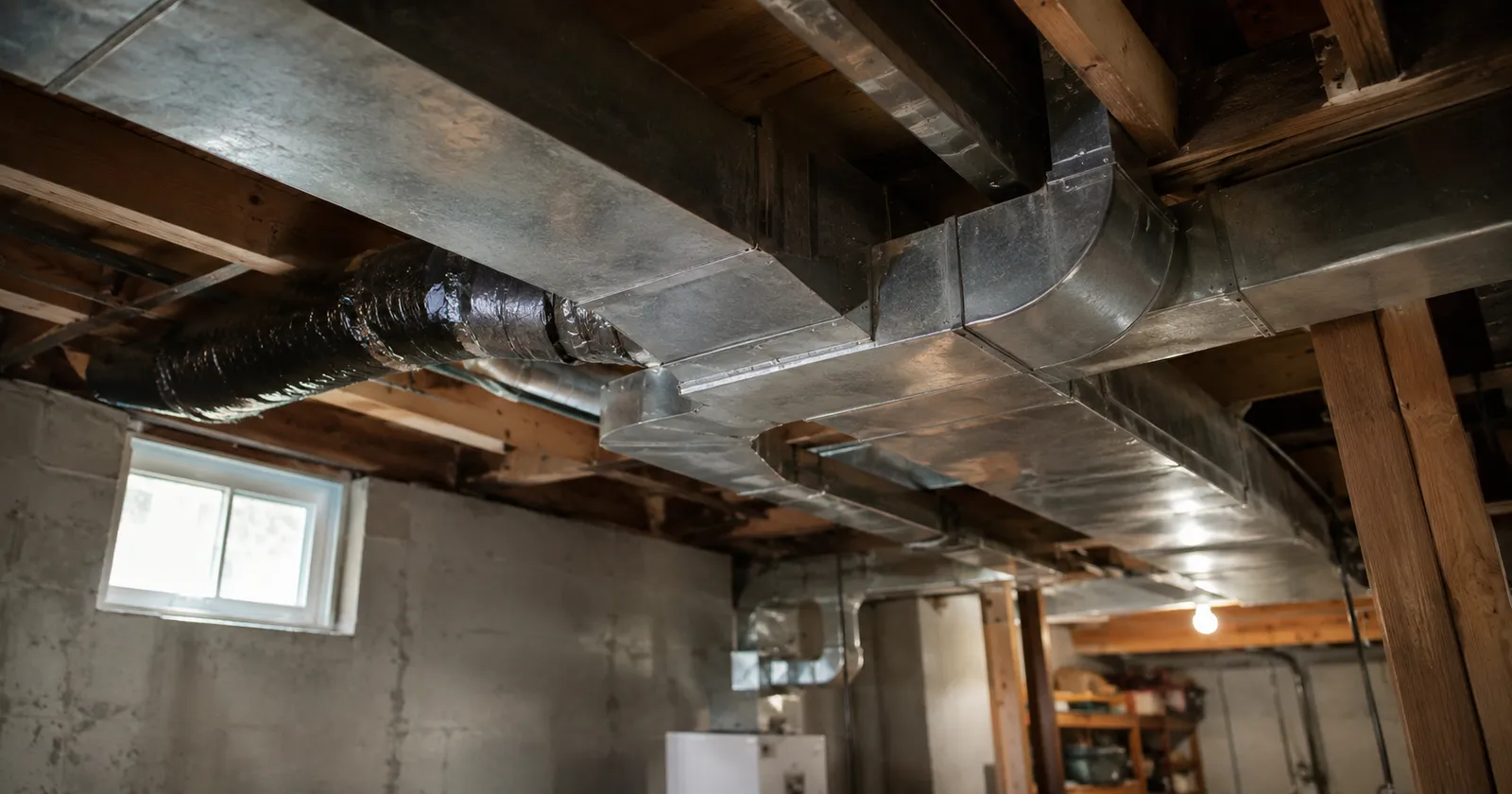
"How much does ductwork cost?" is a fair question with an annoying answer: it depends more on your house than on your ducts. The metal itself is a modest share of the bill. What actually sets the price is how hard it is to get to — and that's why online calculators and real quotes so often disagree.
Still, "it depends" is not useful when you're trying to budget. So here are real ranges — by the foot, by house size, and for the smaller jobs most people actually need — what moves them, how long ducts actually last, and, the question that saves people the most money, how to tell whether you need replacement at all.
Everything below is a planning estimate, not a quote, current as of September 2026. Figures are in Canadian dollars unless explicitly labelled US — some of the most-cited tables online are US national averages, and where we use one we say so rather than quietly converting it. All figures are before tax; Nova Scotia's HST is 14%. Prices move with material costs, and the scope of your specific project determines the actual cost. We've deliberately framed these toward the higher end: we'd rather you budget generously and come in under than plan around a best-case number and get caught short.
What ductwork actually costs
Two ways to look at the number, both useful.
By the linear foot, which is how duct is actually priced:
- Insulated flexible duct — roughly $15–$25 per linear foot installed.
- Rigid galvanized sheet metal — roughly $30–$45 per linear foot installed.
Those are published Canadian per-foot ranges, and they're the most transferable numbers on this page — per-foot pricing survives across markets better than whole-job totals do.
Sheet metal costs more up front and lasts far longer, which is most of the argument for it.
By the whole job, published figures for a 1,500 sq ft home tend to cite $4,500–$7,500 for a full replacement. Take that as the easy-access floor, not the expected price. It assumes an open basement and a cooperative layout. Once you're working through finished ceilings, across multiple storeys, or adding returns that were never there, $8,000–$12,000 or more is a more realistic planning figure — and a large or genuinely difficult house can exceed it. Where a home has no ducts at all and a system goes in from scratch, the combined equipment-and-ductwork figure can reach $15,000 or more.
On a typical job materials are the single biggest line — commonly put at 40–50% of the total — with most of the remainder being labour. That split is the tell: a large share of what you're paying for is time in awkward spaces, not steel, which is exactly why the same duct costs very different amounts in two different houses, and why no honest number exists before someone has seen yours.
What it costs by house size — and why access matters more
This is the most-asked version of the question. The Canadian figures below come from HomeStars' HVAC and ductwork cost data, which prices the Canadian market in Canadian dollars.
The useful thing about the Canadian data is that it does not sort primarily by floor area — it sorts by whether the house is finished, which is the same thing this page has been saying all along:
| Ductwork scenario (Canada, CAD) | Published range |
|---|---|
| New build or unfinished basement, typical 1,500–2,000 sq ft home | $2,000 – $5,000 |
| Finished home — the added cost of getting ducts in | +$3,000 – $8,000 |
| Minor duct repairs | $500 – $3,000 |
| Full duct replacement | $5,000 – $12,000 |
| Gas furnace + ductwork, unfinished basement | $7,000 – $12,000 |
| Furnace + AC + full new ductwork, finished home | $14,000 – $22,000 |
Read the first two rows together, because that is the whole article in two numbers. The same ductwork is $2,000–$5,000 in an open basement and $3,000–$8,000 more once the house is finished. The metal did not change. The access did.
And note that the Canadian full-replacement range — $5,000–$12,000 — lines up with the planning figures at the top of this page rather than contradicting them. That is worth saying plainly: the reason internet ductwork costs often look low is usually that they are American, not that Halifax contractors are expensive.
For a 2,000 sq ft house specifically: the Canadian data puts a typical 1,500–2,000 sq ft home at $2,000–$5,000 where the basement is open, and adds $3,000–$8,000 where it is finished. Which of those two worlds you live in matters far more than the exact square footage.
Three Canadian adjustments no US table can make
You will find plenty of American cost tables for this work, and they are the first thing most people meet. Three reasons they read low here, with currency being the smallest of them:
One: tax. Construction price data conventionally excludes value-added taxes — Statistics Canada says so of its own index, and published cost tables follow the same convention. Nova Scotia's HST is 14%, after the province cut the provincial portion to 9% on 1 April 2025. Your invoice will not exclude it.
Two: a different steel market, and right now that is not a small difference. Statistics Canada's building construction price index for Q2 2026 found the metal fabrications division led residential construction cost growth in Canada — the largest quarterly increase of any division — and attributed it to "upward price pressure associated with implemented retaliatory tariffs and the related supply chain disruptions" on metal and steel, alongside an already constrained skilled trades workforce. Ductwork is metal fabrication. A US table cannot price a Canadian tariff on the steel we buy, by definition.
Three: Halifax is not the national average. In that same quarter, residential construction costs in Halifax rose 2.1% — among the largest increases of the fifteen census metropolitan areas Statistics Canada tracks, against a 15-CMA composite of 0.5% for the quarter and 2.3% year over year. Toronto, Vancouver and Calgary actually fell. Halifax, St. John's and Moncton are the three Atlantic CMAs in that index, and the Atlantic ones were not the ones going down.
Square footage is a weaker predictor than it looks. Two 2,000 sq ft Halifax homes can be thousands apart: a bungalow with an open basement and a three-storey century home with plaster ceilings have almost nothing in common from a duct perspective, whatever their floor plans say. What sets the price is how much duct there is and how hard it is to reach — which is why the next section matters more than this one.
What drives your number up or down
Two houses the same size can quote thousands apart. The reasons are consistent:
- Access. The dominant factor. An open, unfinished basement is quick work. Running new trunk through finished ceilings, closed walls, or a tight crawlspace means opening things up, working in constrained space, and repairing afterward.
- Layout and storeys. A single-storey ranch on a slab-free basement is straightforward. Getting supply and return to a third floor is not.
- How much is custom. Standard fittings are cheap. Odd angles, tight joist bays, and awkward transitions need custom-fabricated pieces — better results, more shop time.
- Returns. Older homes are chronically short on return air. Adding returns where none exist means new runs and new grilles, and it's frequently the difference between a system that works and one that doesn't.
- Material choice. Sheet metal over flex, insulation levels, and sealing method all move the total.
- What's behind the walls. In pre-1980s homes, old duct insulation and tape can contain asbestos. If it turns up, it's licensed abatement work that has to happen separately, by a specialist, before duct work continues. We don't do abatement — but we'll tell you straight if we think you're looking at it.
Why the calculator says one thing and the quote says another
Online ductwork cost calculators take a floor area and a material choice and multiply. That is a reasonable way to get an order of magnitude and a poor way to predict a bill, because every item in the list above is invisible to them.
A calculator cannot see the plaster ceiling that has to come down and go back up, the crawlspace you can only work in on your side, the third floor, the returns that were never installed, the joist bay that needs a fabricated transition rather than a stock fitting, or the asbestos tape on the old duct insulation. Most are also built on US national averages. So a calculator and a real quote can differ by thousands and both be honest — the calculator priced the duct, and the quote priced the access. If you want the calculator number to mean something, treat it as the material floor and assume the labour above it is where your house makes itself felt.
How long ductwork actually lasts
Lifespan is mostly a material question, and the spread is wide:
- Rigid galvanized sheet metal — the number usually quoted in the trade is 25 years, but that badly undersells it, and it's worth knowing by how much. InterNACHI's standard life-expectancy chart, the reference home inspectors actually work from, puts ducting at 60 to 100 years. Metal duct doesn't rot, mould, or degrade on its own; installed properly in a dry basement it can outlive several furnaces.
- Insulated flexible duct — much shorter, more typically 10–15 years. The inner liner tears, insulation compresses, and long unsupported runs sag into airflow-killing curves. This is the material that genuinely wears out.
- Duct board / fibreglass — shorter still, and vulnerable to moisture damage.
One Atlantic Canada caveat on that 60-to-100-year figure, because it is a US chart. InterNACHI's number describes the material under reasonable conditions, and metal genuinely does not wear out on its own. But that chart is not written for a coastal maritime climate, and Nova Scotia basements are frequently damp: Natural Resources Canada's own basement guidance treats dampness, condensation and summer moisture on cool foundation surfaces as normal problems to look for here, not edge cases. Galvanized steel sitting for decades in a chronically damp basement, or anywhere salt air reaches it, will not quietly hit the top of that range.
So read the chart as "metal doesn't have an expiry date," not as a warranty. In this climate, condition is the measurement and the chart is only the prior — which is the same conclusion the rest of this page reaches by a different route, and the reason we look before we quote.
The honest summary, and the reason we lead with the inspectors' number rather than the trade's: age alone is a very weak reason to replace metal ductwork. A system being twenty or thirty years old tells you almost nothing, because the inspection standard expects it to last two to four times that. If a contractor's opening argument is "it's twenty years old," ask what they actually found. Condition and sizing are the real criteria.
When ducts genuinely need replacing
The signals that matter:
- Rust, corrosion, or moisture damage — particularly in a damp basement or crawlspace.
- Crushed, collapsed, or disconnected runs — a section that came apart is dumping conditioned air into a joist bay.
- Sagging flex on long runs, throttling airflow with every curve.
- Undersized for the system — the big one in retrofits. Ducts sized for an oil furnace often can't move the volume a heat pump needs. That's not wear; it's a mismatch, and no amount of good condition fixes it.
- Missing returns, which starve the system no matter how good the supply side is.
- Persistent symptoms — rooms that never warm up, high bills, whistling, dust — that survive sealing and balancing.
The middle ground most homes actually need
Here's the part that saves money: full replacement is the exception, not the rule.
Most houses need targeted work — sealing the leaky joints, replacing the few sections that have failed, resizing an undersized trunk, adding the return that was never there. That's a fraction of a full replacement and it fixes the majority of real complaints. Duct sealing alone addresses a surprising share of comfort problems, since a typical system leaks 20–30% of the air it moves.
Full replacement earns its cost in a few clear cases: the system is undersized throughout, corrosion is widespread, the layout is fundamentally wrong, or the ducts are being rebuilt anyway as part of a furnace conversion. Outside those, partial rework is usually the better buy — and if someone quotes a full replacement without walking your system first, get a second opinion.
The full catalogue of what tends to be wrong is in our guide to common ductwork problems in older Halifax homes.
What the smaller jobs cost
Most enquiries we get aren't "replace everything." They're one room, one run, one problem. Published figures for the common small jobs:
- Minor duct repairs, which is the category a single added vent usually falls into — Canadian data puts these at $500–$3,000 depending on scope. We looked for a published Canadian figure for "add one vent" specifically and could not find one, so we are not going to convert an American number and present it as local.
- Duct sealing rather than replacement — a fraction of a replacement, and it addresses a surprising share of comfort complaints on its own.
But the number is the less important half of the answer. A new supply vent only helps if the system has the capacity and the return air to feed it. Tapping another run off a trunk that is already at its limit doesn't create air — it borrows it from the rooms currently being served, which is how a $350 job turns into a house that's worse balanced than before. The same is true of extending duct into a newly finished basement or an addition, where the capacity question decides the job and the ceiling type decides the price.
So the first question is never what the run costs. It's whether the system can carry it at all — and that check comes before the quote, not after it. If someone will add a vent without looking at the trunk and the returns first, that is the thing to worry about, not the price.
The Halifax wrinkle: conversions
A lot of local duct spending right now isn't about worn-out ducts at all — it's about changing systems. Halifax has a large stock of postwar homes built around oil furnaces, and when those convert to a heat pump, the ductwork question arrives with it.
An oil furnace pushes small volumes of very hot air. A heat pump moves larger volumes of cooler air, which needs more duct capacity and considerably more return. Ducts that served the furnace faithfully for forty years can be genuinely undersized for the new equipment — in good condition and still wrong for the job. That's the single most common reason a Halifax homeowner gets a ductwork quote in 2026. There's more on that specific job in our oil furnace to heat pump conversion guide and on ductwork sizing for ducted heat pumps.
Worth knowing before you budget: rebate programs are aimed at the equipment, not the air side. The duct work usually sits outside what they cover, so scope it early rather than discovering the gap after the heat pump is ordered.
Getting a quote worth trusting
A few things separate a real quote from a number:
- They looked at the whole system, not just the piece you complained about.
- They measured or calculated, rather than eyeballing what "should" fit.
- They checked the returns, not only the supply side.
- They told you what you don't need. A contractor who talks you out of the expensive option when the cheap one will work is showing you how they'll behave later.
- The scope is written down — what's being replaced, what's being sealed, what's being left alone. Scope is the price; a number without a scope attached isn't a quote, it's a guess.
Where we fit in
Ductwork is our trade, so we'll give you the straight version: most homes we look at need less than they expect, and the ones that need more usually need it for sizing reasons, not age. We assess what's there, tell you honestly what it needs, and quote the air side clearly — resizing, sealing, returns, transitions, and custom fabrication where the layout calls for it. Refrigerant work and commissioning go to our licensed heat-pump partners; the air side is ours.
And to say it once more plainly, because it's the honest bottom line on any cost article: every figure here is an estimate. The scope of the work — how much duct, how accessible, what has to be opened up, what the new system actually demands — is what determines the cost. If you want a real number for your house rather than a range from the internet, get in touch. A look at the system is what turns "it depends" into a figure you can budget against.
Sources
Every figure here is a planning estimate, not a quote — the scope of your job sets the cost, which is the point the whole article makes. No official schedule exists for this work in Canada, so cost ranges come from published market data; treat them as the shape of the market, not a price list. Figures are in Canadian dollars unless explicitly labelled US, and all are before tax. Last verified September 7, 2026.
Why we sort sources by country. Most ductwork cost data online is American, and the gap is not only the exchange rate — it is a different tax regime, a different steel market, and different housing. We lead with Canadian sources and mark every US figure with what does and does not carry over.
Canadian and Atlantic sources
- Statistics Canada — Building construction price indexes, second quarter 2026 (released 24 July 2026). Source of three things this page leans on: Halifax residential construction costs rose 2.1% in the quarter against a 15-CMA composite of 0.5% (and 2.3% year over year); the metal fabrications division led residential cost growth nationally, which is our trade; and StatCan's attribution of that to "upward price pressure associated with implemented retaliatory tariffs and the related supply chain disruptions" on metal and steel, plus a constrained skilled-trades workforce. Halifax, St. John's and Moncton are the three Atlantic CMAs in the index. Note also StatCan's own methodology statement that the index excludes value-added taxes — the same convention published cost tables use, and the reason HST is a separate line below.
- Canada Revenue Agency — GST/HST rates by province. Nova Scotia's HST is 14%, after the province cut the provincial portion to 9% on 1 April 2025. Published cost figures, ours included, are before tax.
- HomeStars (Canadian, CAD) — HVAC and ductwork installation cost data for Canada. Source of the cost table on this page: the $2,000–$5,000 unfinished-basement range for a 1,500–2,000 sq ft home, the +$3,000–$8,000 finished-home premium, $500–$3,000 minor repairs, $5,000–$12,000 full replacement, and the whole-system figures. We use Canadian cost data rather than the US tables that dominate this search, because on cost the exchange rate is the smallest of the differences between those markets. (Verification note for future checks: this URL returns 403 to a command-line request but loads normally in a browser — a firewall rule, not a dead link. All four figures above were confirmed on the live page on 7 September 2026.)
- Canadian per-linear-foot pricing (CAD) — ductwork installation cost breakdown for the $15–$25 (flex) and $30–$45 (galvanized steel) per-foot ranges and the materials share of a typical bill. This source states its figures in Canadian dollars. It is a trade publisher rather than an official series, which is why we present it as market shape and not as a schedule.
- Natural Resources Canada — Keeping the Heat In, Section 6: Basement insulation, for the point that basement dampness and summer condensation on cool surfaces are normal conditions to check for in Canadian housing — which is why we caveat the US lifespan chart rather than quoting it flat.
US sources, and how far they travel
- InterNACHI (US) — see the entry above. It is the only non-Canadian source left on this page, it is not a cost source, and it carries its scope note.
- InterNACHI (US) — the Standard Estimated Life Expectancy Chart for Homes, source of the 60-to-100-year figure for ducting. What transfers: metal duct has no expiry date and does not degrade on its own. What does not: it is not written for a coastal maritime climate. In damp Nova Scotia basements, or where salt air reaches the metal, condition governs and the chart is only a starting assumption.
On disagreements, and one source we removed
The trade commonly quotes 25 years for metal duct; InterNACHI's inspection chart says 60 to 100. We lead with the inspection standard, because it is a professional reference rather than a sales position and because it matches what metal duct actually does in a dry basement — with the Atlantic damp-and-salt caveat above, which is the part a US chart cannot carry.
On cost, a note about what changed here. This page previously built its by-house-size table on HomeGuide, a US aggregator. That has been removed and replaced with Canadian data, because cost is one of the categories where an American figure is wrong here by construction — currency, 14% HST, a Canadian steel market under tariff pressure, and a Halifax market running above the national average. The Canadian numbers turned out to agree with the planning ranges this page already gave, which the US table appeared to contradict. The disagreement was never with reality; it was with a source from another country.
Related services
Frequently asked questions
How much does it cost to replace ductwork?
Treat any figure you read as an estimate, not a quote — the scope of the specific project is what sets the cost. That said, for planning: a full replacement in a typical 1,500 sq ft Canadian home commonly starts around $4,500–$7,500 where access is easy, and realistically runs $8,000–$12,000 or beyond once finished walls, multiple storeys, added returns, or custom transitions come into it. We'd rather you budget toward the higher end and be pleasantly surprised than plan on the lowest number online and get a shock. Per linear foot it's roughly $15–$25 for insulated flex and $30–$45 for galvanized sheet metal, with materials commonly making up 40–50% of the total and most of the rest being labour. The biggest swing factor isn't the duct itself, it's how hard your house is to work in.
How long does ductwork last?
It depends heavily on the material, and the gap is bigger than most people expect. Rigid galvanized sheet metal is the durable option: the trade often quotes 25 years, but InterNACHI's standard life-expectancy chart — the reference home inspectors work from — puts ducting at 60 to 100 years, because metal doesn't rot, mould, or degrade on its own. Insulated flexible duct is the shorter-lived one, more typically 10–15 years, since the inner liner tears, the insulation compresses, and long sagging runs choke off airflow. One caveat worth attaching, because that chart is American: it describes the material under reasonable conditions, and it is not written for a coastal maritime climate. Nova Scotia basements are often damp, and Natural Resources Canada treats basement dampness and summer condensation as normal things to look for here. Galvanized steel in a chronically damp basement, or where salt air reaches it, will not quietly reach the top of that range. A general rule: if your ducts are rigid metal and dry, age alone isn't a reason to replace them. If they're flex and over 15, or metal in a wet basement, they're worth inspecting.
Should ductwork be replaced after 20 years?
Not automatically, and we'd be suspicious of anyone who says otherwise without looking. Twenty-year-old galvanized sheet metal in a dry basement is often in genuinely good condition and has decades left. What actually triggers replacement is condition and fit, not birthdays: rust or crushed sections, joints that have come apart, or ducts that are simply the wrong size for the system you're putting in. Plenty of older Halifax homes need their ducts reworked because a heat pump needs more airflow than an oil furnace did — that's a sizing problem, not an age problem.
Is it cheaper to repair ductwork or replace it?
Repair, almost always — and it's the right answer more often than people expect. Sealing leaky joints, replacing a few crushed or disconnected runs, and adding a missing return costs a fraction of a full replacement and fixes most real-world complaints. Full replacement earns its cost when the system is undersized throughout, badly corroded, or being rebuilt anyway for a furnace conversion. An honest contractor should tell you which category you're in before quoting the expensive one. Either way the figure depends on scope — how much duct, how accessible, and what has to be opened up to reach it.
How much does it cost to replace ductwork in a 2000 sq ft house?
Canadian cost data puts a typical 1,500 to 2,000 sq ft home at roughly $2,000 to $5,000 where the basement is open and the ducts are easy to reach, and adds about $3,000 to $8,000 on top where the house is already finished and ceilings have to be opened and repaired. Full replacement is put at $5,000 to $12,000. Read those first two figures together, because they are the real answer: the same ductwork costs very different amounts depending on access, and that matters far more than the exact square footage. Two 2,000 sq ft Halifax homes can be thousands apart if one is a bungalow over an open basement and the other is a three-storey with plaster ceilings. Be careful with American cost tables on this question — they read low here for reasons beyond the exchange rate, including that Nova Scotia HST is 14% and that Canadian metal prices have been rising faster than the US figures reflect. All figures are before tax and are planning estimates, not quotes.
How much does it cost to add a vent to existing ductwork?
We could not find a published Canadian figure for this specific job, and we would rather say that than convert an American one, so here is the honest version instead. Adding a single vent to ductwork that already exists is a much smaller job than a replacement, and it sits at the bottom of the Canadian minor-duct-repair range, which published data puts at $500 to $3,000 depending on what is involved. But the caveat matters more than the number: a new vent only helps if the system has the capacity and the return air to feed it. Tapping another supply off a trunk that is already at its limit takes air away from somewhere else and can make the overall balance worse, which is why the first question should be whether the system can carry the extra run at all, not what the run costs. That check is free and it is the part worth insisting on.
How much does it cost to install an HVAC system with ductwork in Canada?
For a home with no ducts at all, the combined equipment-and-ductwork figure commonly reaches $15,000 or more, and ducted heat-pump projects in Nova Scotia are frequently quoted in that territory once the air side is included. Be careful how those quotes are assembled, because this is where budgets break: heat-pump pricing is built around the equipment, and the duct work — resizing, sealing, added returns, a new plenum transition — is often quoted thinly or assumed away. Rebate programs generally target the equipment, not the ductwork. We only quote the air side, and we would rather scope it separately and early than have you discover the gap after the equipment is ordered.
Can I trust an online ductwork cost calculator?
Use one to get a rough order of magnitude and then stop. Calculators take square footage and a material choice and multiply, which misses the variable that actually sets the price: how hard your house is to work in. They cannot see finished ceilings that have to be opened and repaired, a tight crawlspace, a third floor, missing returns, custom transitions for awkward joist bays, or asbestos-containing insulation around old duct tape. Most are also built on US national averages in US dollars. That is why a calculator and a real quote can differ by thousands and both be honest — the calculator priced duct, the quote priced access.
What makes ductwork cost more than the quote I saw online?
Access, mostly. Online figures and calculators assume an open, workable basement, and most of them are US national averages in US dollars rather than Canadian numbers. Costs climb when ducts run through finished ceilings and walls that have to be opened and repaired, when the house has multiple storeys or a tight crawlspace, when the layout needs custom-fabricated transitions rather than off-the-shelf fittings, and when returns have to be added where none exist. In older homes, discovering asbestos-containing materials around old duct insulation or tape also changes the job — that's specialist abatement work that has to be handled separately before duct work continues.
Does new ductwork come with the heat pump quote?
Usually not the full cost of it, and this is where budgets get blown. Heat-pump quotes are built around the equipment, and the air-side work your ducts may need — resizing, sealing, added returns, a new plenum transition — is often quoted thinly or assumed away. Rebate programs generally target the equipment, not the ductwork. Get the duct side scoped separately and early so you're budgeting the whole project rather than discovering the gap after the equipment is ordered.
Questions about your own home?
Tell us what's happening and we'll give you a straight answer and a practical quote.
Request a Quote