Leaky Ducts & Duct Sealing: Is It Worth It?
Most duct systems leak — the U.S. Department of Energy estimates 20–30% of the air moving through them escapes through loose joints, gaps, and disconnected runs, much of it wasted into unheated basements and attics. Sealing pays off most when the ducts run through those unconditioned spaces. Accessible joints are sealed by hand with mastic or UL-181 foil tape (never cloth duct tape); hidden leaks inside a closed system can be sealed with Aeroseal, an aerosolized sealant. Sealing won't fix undersized ducts, too few returns, or crushed runs — those need physical repair, not sealant.
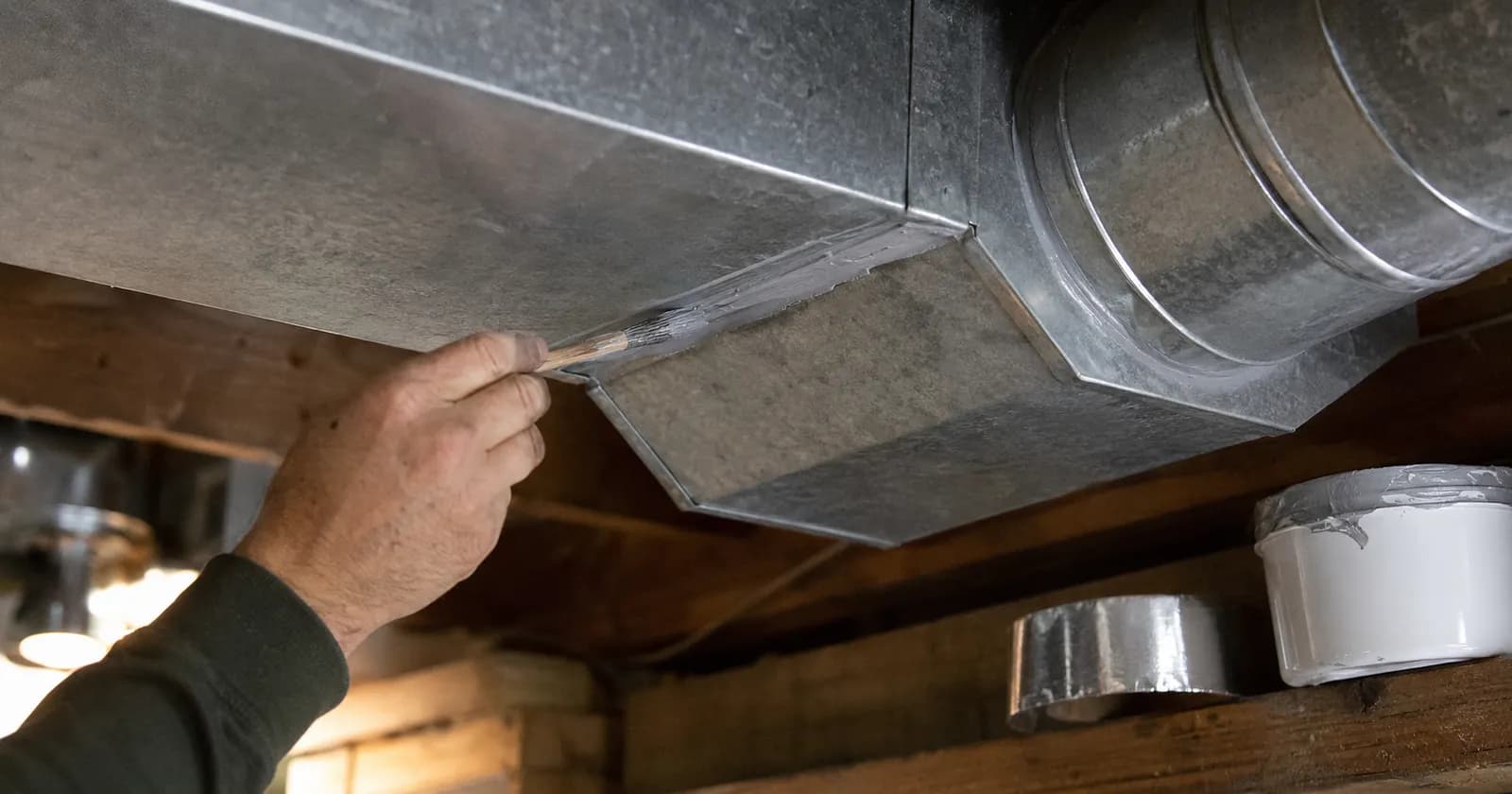
Almost every duct system leaks. The U.S. Department of Energy puts it at "about 20%-30% of the air that moves through the duct system" being lost to leaks, holes, and poorly connected ducts — and if those ducts pass through an unheated basement, attic, or crawlspace, that's air you paid to heat, escaping where it does you no good.
Worth reading that number as a Canadian, though. It's a US figure, weighted by US housing stock, where ducts very commonly run through vented attics and crawlspaces — outside the heated envelope. Plenty of Halifax homes run their ducts through a heated basement instead, and air that leaks out there still ends up in the house. In that case sealing is still worth doing, but the honest case for it is comfort and balance rather than the full 20–30% as straight heat loss: leaks bleed off pressure before the air reaches the room it was meant for, and NRCan names leaky ductwork as a reason balancing attempts fail outright. Where the DOE figure transfers directly is any run through an unheated basement, crawlspace, attic or attached garage — and those are common enough here that the number earns its place on this page. It just isn't one-size-fits-all, and where your ducts actually run decides which version applies to you. Sealing the leaks is one of the best-value things you can do to a forced-air system. But "seal the ducts" isn't one job with one price, and it isn't the right fix for every airflow problem. Here's how to tell what your ducts need.
What leaky ducts actually cost you
A duct leak isn't dramatic — there's no puddle, no alarm. It just quietly bleeds off a share of every dollar you spend on heat. When that leak is in a finished, conditioned space, the escaped air at least stays in the house. When it's in an unconditioned space — the basement, an attic, a crawlspace, a garage — it's a total loss. You're heating the joists before you heat the bedrooms.
The signs are familiar and easy to write off:
- Higher heating bills than the house's size and insulation should call for.
- Rooms that never quite warm up, especially the ones farthest from the furnace or air handler.
- A dusty house, because return-side leaks pull dust and attic air into the system.
- Whistling or a rush of air audible near the ducts when the system runs.
None of it screams "duct leak," which is why leaks go unaddressed for years while the meter keeps running.
Where ducts actually leak
Leaks concentrate at the connections, not in the middle of a straight run:
- Joints and seams where sections of duct meet, especially if they were only tacked with screws and old tape.
- Register and grille boots where the duct meets the floor or wall.
- The plenum and takeoffs at the furnace or air handler — big surfaces, lots of seams.
- Disconnected or fallen runs that came apart entirely and now dump into a joist bay or the basement.
The leaks that matter most are the ones in unconditioned space. Sealing a joint in a finished, heated basement saves a little; sealing the same joint on a run through a cold attic saves a lot.
The three ways to seal ducts
There's no single "duct sealing." There are three approaches, and good work often combines them:
-
By hand with mastic. For joints and seams you can reach, water-based mastic is the gold standard — it brushes on as a paste and cures into a durable, flexible, airtight seal that outlasts any tape. This is the workhorse of a proper sealing job.
-
UL-181 foil tape for smaller cracks and tight spots where a brush won't fit. It's the right tape for the job — and worth saying plainly: never use cloth "duct tape." This isn't folklore, and it isn't only an American view. Natural Resources Canada specifies aluminum foil duct tape, approved flexible plastic tape or water-based mastic, and says not to use standard vinyl duct tape because "the adhesive dries out over time and the tape falls off." ENERGY STAR is equally blunt ("Never use duct tape, as it is not long-lasting"), and Lawrence Berkeley National Laboratory baked and aged duct sealants for years and found essentially every product worked except cloth-backed tapes with natural rubber adhesives — the one everyone reaches for.
One Canadian addition the US sources don't make: NRCan warns not to seal or wrap duct within 1.8 m (6 ft.) of a wood-fired furnace unless you use approved non-combustible tape, mastic or insulation. That still matters in parts of Nova Scotia.
-
Aeroseal for the leaks you can't reach. It's an aerosolized sealant blown through the pressurized duct system that finds and plugs leaks from the inside — including ones buried in walls, ceilings, and chases where no brush or hand can go.
Which combination is right depends entirely on where your leaks are and how accessible they are.
Is Aeroseal worth it?
This is the question most people are really asking, so here's the honest version. Aeroseal genuinely works, and it reaches hidden leaks that hand-sealing simply can't. On the numbers, be careful whose you're reading: "up to 90% of duct leakage sealed" is the manufacturer's own published claim, and "up to" is doing real work in that sentence. It's a ceiling from ideal conditions, not an average — what any given house gets depends on how leaky it was to begin with, how much of the system the aerosol can pressurize, and the size of the gaps (the process closes small leaks, not open disconnections). Treat a specific percentage promised before anyone has tested your ducts as a sales figure. Canadian dealers commonly quote residential packages in the $1,500–$3,000 range, and in a leaky home the energy saved can pay that back over several years.
One practical point that rarely gets said out loud: Aeroseal is proprietary equipment run through a certified dealer network, not a technique any HVAC contractor can perform. So it's always a referral, and anyone who tells you otherwise is guessing.
It's worth it when a meaningful share of your ductwork is inaccessible — buried in walls and ceilings, in a finished space, or in a sprawling attic run — because that's exactly the leakage you can't get at by hand.
It's not worth it when your leaks are accessible basement joints. Those can be sealed by hand with mastic for a fraction of the cost, and paying for an aerosolized system to do what a brush and an afternoon can do is spending money for its own sake.
And it's not a cure-all either way. Aeroseal seals gaps; it can't resize an undersized duct, add a return that was never there, or reconnect a run that's fallen apart. Anyone selling it as the answer to every airflow complaint is overselling it. We treat it as one tool among several, and only recommend it where it actually pays off.
What sealing can't fix
Sealing solves one specific problem: air escaping through gaps. It does nothing for the problems that get blamed on leaks but aren't:
- Undersized ducts that can't carry enough air no matter how airtight they are.
- Too few cold-air returns, which starve the system regardless of leakage.
- Crushed or kinked flex that chokes airflow at a pinch point.
- A layout that was never balanced and favours the nearest rooms.
These need physical work — resizing, adding returns, replacing bad sections — not sealant. If your real issue is one of these, sealing alone will disappoint you. It's why we diagnose the whole system before reaching for any one fix; the full rundown of what goes wrong is in our guide to common ductwork problems in older Halifax homes. Sealing is also a standard part of a furnace conversion, where the ducts are getting reworked anyway.
Where we fit in
Duct sealing is air-side work — our trade. We don't lead with one method and sell it to everyone; we look at where your ducts run, find where they leak, and seal the joints that are costing you, using mastic and proper tape where we can reach and recommending Aeroseal only where hidden leaks justify it. If your bills are high, a room won't warm up, or you just want the system you have to stop wasting what it makes, that's a straightforward thing to assess across Halifax HRM — and often a cheaper fix than people expect.
Sources
Cost figures on this page are planning estimates in Canadian dollars, drawn from published North American ranges and Canadian dealer pricing — not quotes. Duct sealing is priced by how much duct you have and how much of it can be reached, so the only real number comes from seeing the system. Everything here was last verified on September 7, 2026.
A note on nationality. Most duct advice online is American, and the difference isn't only currency — it's where the ducts are. US housing commonly runs duct through vented attics and crawlspaces outside the heated envelope; a lot of Halifax housing runs it through a heated basement. That changes how much leakage actually costs you. We flag each source's origin below.
- Natural Resources Canada (Canadian) — Keeping the Heat In, Section 9: Operating your house, source of the Canadian sealing-materials guidance (foil tape, approved flexible plastic tape or water-based mastic, never standard vinyl duct tape), the 1.8 m (6 ft.) wood-furnace clearance, and the point that leaky ductwork is a common reason balancing fails.
- U.S. Department of Energy (US) — Home Upgrades: Duct Sealing, source of the 20–30% duct-loss figure. Applies directly to duct in unheated space; overstates the heat-loss case for duct inside a heated basement, as the page now says.
- ENERGY STAR — Duct Sealing, on sealing with mastic or metal tape and never with duct tape.
- Lawrence Berkeley National Laboratory — Assessing the Longevity of Residential Duct Sealants (Walker & Sherman), the accelerated-ageing work behind the duct-tape verdict.
- Aeroseal — the manufacturer's FAQ and dealer network, source of the "up to 90%" claim and confirmation that the process is dealer-only. We quote that figure as the manufacturer's, because it is: we've found no independent field data to put a trustworthy average against it, so we don't publish one.
Related services
Frequently asked questions
How much air do leaky ducts waste?
The U.S. Department of Energy estimates that 20–30% of the air moving through a typical duct system is lost to leaks, holes, and poorly connected joints. The loss is worst where ducts run through unheated space — a basement, attic, or crawlspace — because air that escapes there is air you paid to heat and will never get back. In a leaky system you're effectively heating the basement before you heat the house.
Is Aeroseal duct sealing worth it?
It can be — for the right home. Aeroseal is an aerosolized sealant blown through pressurized ducts that plugs leaks from the inside, including hidden ones you can't reach by hand. "Up to 90% of duct leakage sealed" is the manufacturer's own published claim — a ceiling from ideal conditions rather than an average, so treat any specific percentage promised before your ducts are tested as a sales figure. A typical Canadian residential job is often quoted in the $1,500–$3,000 range. It's worth it when a lot of your duct is buried in walls, ceilings, or hard-to-reach chases. It's overkill when the leaks are accessible basement joints that can be sealed by hand for less — and it won't fix undersized ducts, missing returns, or disconnected runs. It's also dealer-only equipment, so it's a referral, not something every contractor can do. We look at the whole system before recommending it.
How much does duct sealing cost?
It depends on the method and how bad the leakage is. Hand-sealing accessible joints with mastic and foil tape typically runs a few hundred to roughly $1,900, since it's mostly labour. Aeroseal, which reaches hidden leaks, is usually $1,500–$3,000 (more for large or badly leaking systems). DIY materials — a tub of mastic and UL-181 foil tape — are inexpensive, but you can only seal what you can actually reach. The honest number comes from seeing how much duct you have and where it leaks.
Can I seal my ducts myself?
The accessible joints in a basement, yes — brush water-based mastic over the seams, or use UL-181 foil tape on smaller gaps. Just never use cloth 'duct tape': despite the name, it dries out and peels off within a few years. The catch is that DIY only reaches what you can see and touch; leaks up in an attic, inside a wall, or on the back of a run you can't get to stay open. That hidden portion is exactly what a professional or Aeroseal is for.
What's the best way to seal ductwork?
For joints and seams you can reach, mastic is the gold standard — it brushes on wet and cures into a durable, flexible, airtight seal. UL-181 foil tape handles smaller cracks and hard-to-reach spots. For leaks hidden inside a closed system, Aeroseal is the tool. The one thing to avoid entirely is standard cloth duct tape, which fails within a few years. Most real jobs use a combination, matched to where the leaks actually are.
Will sealing my ducts fix uneven heating?
Sometimes — if the reason one room runs cold is that air is leaking out before it gets there, sealing helps a lot. But uneven heat often has other causes: undersized ducts, too few cold-air returns, or a layout that favours the closest rooms. Sealant can't resize a duct or add a return. We diagnose why the system is uneven first, then seal, resize, or add returns as the actual problem calls for.
Questions about your own home?
Tell us what's happening and we'll give you a straight answer and a practical quote.
Request a Quote