Range Hood Make-Up Air in Nova Scotia: What the Building Code Actually Requires
Not because of the hood's size. The 400 CFM threshold you see quoted is from the US International Residential Code, which Nova Scotia does not use. Nova Scotia builds to the National Building Code of Canada 2020, and its make-up air rule, Article 9.32.3.8, has no CFM threshold at all. It applies when the home has a fuel-fired furnace, boiler or water heater that is not direct-vented or mechanically vented, such as an oil furnace on a chimney. In that house, any exhaust device other than the principal ventilation fan, however small, needs outdoor make-up air supplied by a fan at 100 to 110 percent of its exhaust rate, switched on with it, and either tempered to at least 12 degrees or delivered to an unoccupied area. In a house heated by electricity, a heat pump or sealed-combustion appliances, the article does not apply.
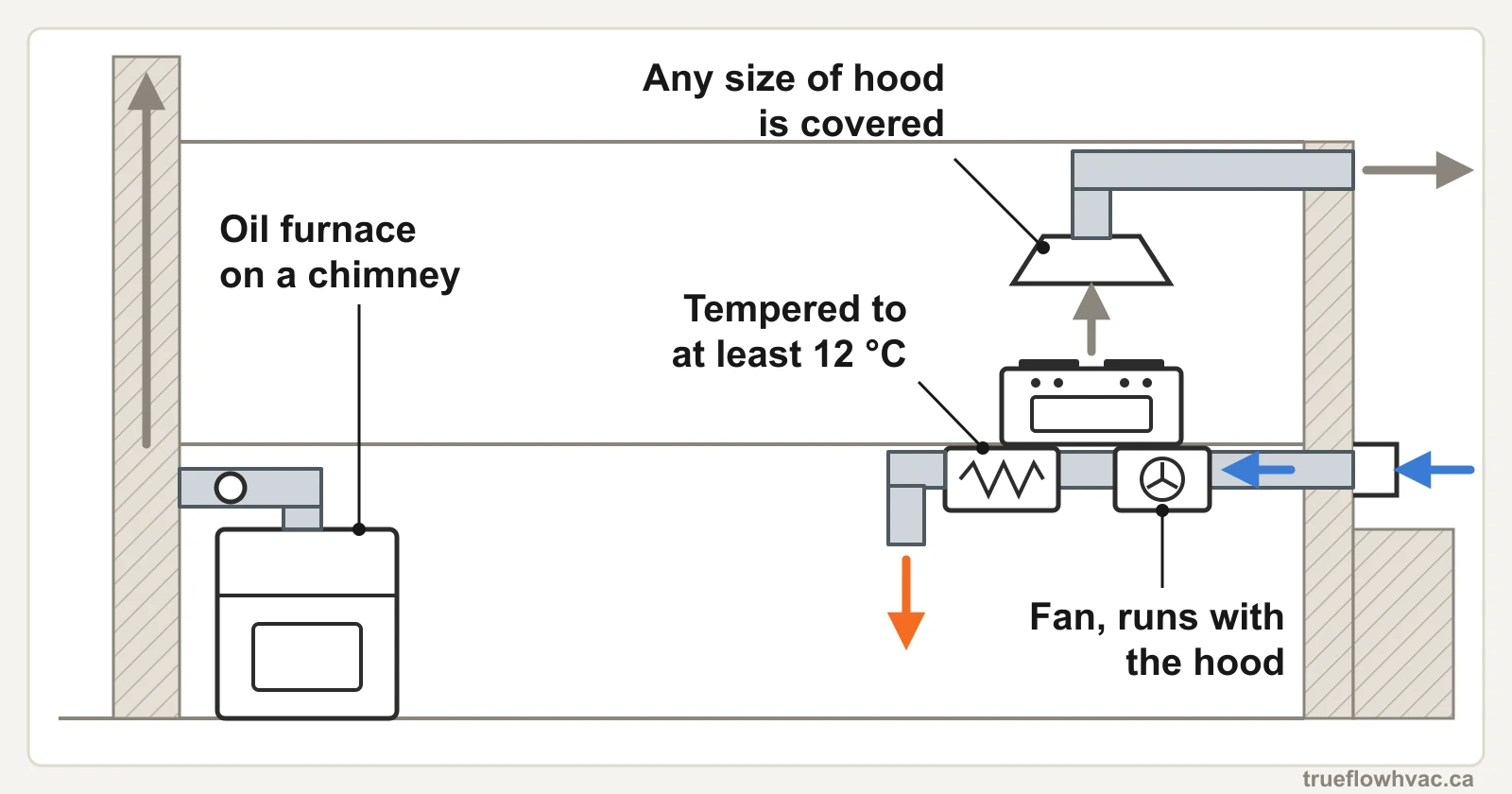
Search for range hood make-up air and you'll be told about a 400 CFM rule. Google's own summary repeats it. Range hood sellers repeat it. It's a real rule, but it's an American one.
Nova Scotia doesn't use that code. We read the one it does use, the National Building Code of Canada 2020, and its make-up air article works differently. It has no CFM threshold at all. What triggers it is what's in your basement, not what's over your stove. Depending on that, a modest hood can need make-up air, and a 1,200 CFM hood in an all-electric house may not need any under this article.
Below is what the code says, clause by clause, for a new house, a renovation and the older house most of Halifax lives in. Where the answer turns on something we couldn't read ourselves, we say so.
The short answer
Nova Scotia adopted the National Building Code of Canada 2020 from 1 April 2025, and the province's Building Code Regulations don't amend the make-up air article. So the national text applies as written. Its make-up air rule, Article 9.32.3.8, turns on one question: does anything in the house burn fuel through a chimney to heat the house or the water?
| Your house | Does the make-up air article apply? | What the code turns on |
|---|---|---|
| Oil furnace or boiler on a chimney | Yes, for any size of hood | A fuel-fired heating appliance that isn't direct-vented or mechanically vented (9.32.3.8.(1)) |
| Fuel-fired water heater on a chimney | Yes | The article names water heaters as well as furnaces |
| Heat pump, electric baseboard or electric furnace, electric water heater | No | No fuel-fired heating or water-heating appliance at all |
| Fuel-fired appliances, all sealed or power-vented | No | They're direct-vented or mechanically vented, the article's exception |
| Heat pump, with the old oil furnace kept as backup | Yes, while that furnace is on the chimney | The appliance is still in the house |
| Woodstove, everything else sealed or electric | No, under this article | Solid-fuel homes are exempt where every other fuel-fired appliance is sealed or power-vented (9.32.3.8.(6)) |
| Existing house, no permit work | The code isn't applied retroactively | The province's regulations cover existing conditions; see below |
Where it applies, the code asks for a lot more than a hole in the wall. The rest of this page shows where each line comes from and what a compliant system actually is.
Where the 400 CFM number comes from
The figure is from the US International Residential Code, section M1503.6. That section requires make-up air where a home has a fuel-burning appliance that isn't direct-vent or mechanically vented and an exhaust system "capable of exhausting in excess of 400 cubic feet per minute." It lets the make-up air be provided "mechanically or passively" at a rate "approximately equal to the exhaust air rate."
The Canadian article starts from the same idea, a fuel appliance that can be back-drafted, and then goes further:
| US code (IRC 2021, M1503.6) | National Building Code 2020, 9.32.3.8 (Nova Scotia) | |
|---|---|---|
| What triggers it | A fuel-burning appliance that isn't direct-vent or mechanical-draft, plus an exhaust over 400 CFM | A fuel-fired space- or water-heating appliance that isn't direct-vented or mechanically vented |
| Size threshold | Over 400 CFM | None. Any mechanical exhausting device other than the principal ventilation fan |
| How the air comes in | Mechanically or passively | By a fan |
| How much | Approximately equal to the exhaust | Not less than the exhaust capacity, not more than 10% above it |
| Cold outdoor air | (Not covered in the section we read) | Tempered to 12 °C, or delivered to an unoccupied area |
The US rule is why so much of what you'll read talks about "big hoods." It isn't the rule here. If a hood seller or a forum tells you a 390 CFM hood dodges make-up air in Nova Scotia, they're quoting the wrong country's code.
What the code actually says
Article 9.32.3.8 is titled Protection Against Depressurization. The parts that matter for a kitchen:
Who it applies to (9.32.3.8.(1)). "Dwelling units that contain a fuel-fired space-heating appliance or fuel-fired water-heating appliance of other than direct-vented or mechanically vented types."
What it requires (9.32.3.8.(2)). "Any mechanical air exhausting device, other than the principal ventilation fan operating at a rate not greater than the maximum permitted by Table 9.32.3.3., shall be provided with outdoor makeup air supplied by a fan rated to deliver outdoor air to the dwelling unit at a rate (a) not less than the exhaust capacity of the device, and (b) not greater than that exhaust capacity plus 10%."
That it runs with the hood (9.32.3.8.(3)). The make-up air fan "shall be wired so that it is activated whenever the device for which it supplies outdoor makeup air is activated."
Where the cold air goes (9.32.3.8.(4) and (5)). It must be "introduced to a normally unoccupied area in the dwelling unit, or tempered to at least 12°C before being introduced to occupied areas or to a supply duct system." If it isn't tempered before the fan, the fan has to be "approved by the manufacturer for the handling of untempered outdoor air."
Three things follow that most advice gets wrong:
- There's no minimum size. The article says any mechanical exhausting device. Where it applies, a 300 CFM hood is covered as much as a 1,200 CFM one.
- A passive opening doesn't meet it. The wording is a fan, rated to a band of 100–110% of the exhaust, switched with the device.
- The bigger the hood, the bigger the job. The make-up air fan has to match the hood's capacity, and so does whatever tempers the air. A 1,200 CFM hood in an oil-heated house means a 1,200 CFM make-up air system.
Why it's about the furnace, not the hood
The code's explanatory note on this article (Note A-9.32.3.8.) sets out the physics plainly. Every cubic foot a hood blows outdoors comes back in somewhere: "The rate of inward leakage will automatically equal the rate of outward extraction." In a leaky house it seeps in through the walls. In a tight one, the house has to drop to a lower pressure to pull the same air in through fewer gaps. An exhaust device not paired with a supply fan, the note says, "will always depressurize a house to some extent—even a leaky house."
That lower pressure is what matters for anything venting up a chimney. The note says appliances "susceptible to pressure-induced spillage" can generally be identified because they're "vented through a natural draft chimney rather than through an arrangement that uses a fan." Its examples include "oil furnaces with barometric dampers." That's the typical older Halifax basement furnace. Pull the house negative enough and combustion gases come down the chimney and into the house instead of going up it.
It also explains why the hood itself can disappoint. Against a high enough pressure difference, the note says, the exhaust device "will no longer be able to achieve its rated flow." A powerful hood in a tight house with no make-up air can move far less than the number on the box, code or no code.
This is a bigger issue in Nova Scotia than almost anywhere else in Canada. In Statistics Canada's 2021 household survey, as reported by the province, 32% of Nova Scotia homes heated primarily with fuel oil, against 3% across Canada. Another 10% heated with wood or pellets. The code trigger that barely touches most of the country applies here in roughly one house in three. That's our reading of the survey: it records the fuel, not how each appliance is vented, and some oil appliances are sealed-combustion types.
It isn't only the range hood
The article says any mechanical exhausting device other than the principal ventilation fan. The code's own fan-noise table (Table 9.32.3.10.-B) lists "supplemental fans installed in bathrooms and their makeup air fans" and the same for kitchens. So in a house the article covers, the code expects make-up air for bathroom fans too.
For a new house, that makes the appliance choice the simplest decision in the whole question. Electric heat, heat pumps and sealed-combustion equipment take the house outside the article.
Three ways the requirement falls away
The article itself lists the exceptions:
- Change the appliance. Replace the chimney-vented furnace, boiler or water heater with electric, a heat pump, or a direct-vented or mechanically vented type, and Sentence (1) no longer applies. If you're already planning an oil-to-heat-pump conversion, this is a reason to take the oil furnace out rather than keep it on the chimney as backup.
- Pass a depressurization test. Make-up air isn't required if it can be shown, using the test procedures in CAN/CGSB-51.71, "Depressurization Test," that the depressurization the appliances and their venting will see stays within that standard's limits (9.32.3.8.(7)). That standard is a separate document we haven't read, so we won't describe its limits.
- Radon fans. A fan running a subfloor depressurization system for radon is exempt (9.32.3.8.(8)). That covers the radon fan, not your range hood.
There's also a design route. The code lets a house's heating-season ventilation be designed to the CSA F326 standard or to Part 6 instead of the prescriptive rules in Subsection 9.32.3 (9.32.3.1.(1)). Part 6's make-up air rule (6.3.2.8.) is written as a performance requirement rather than a fan rating. Those are engineering paths for a designer and a building official to settle, not shortcuts.
Older houses and renovations
The code isn't applied to an existing house just because it exists. Nova Scotia's Building Code Regulations say construction that lawfully existed before the regulations "is not required to conform" to them "if the construction or condition does not constitute an unsafe condition in the opinion of a building official" (section 7(1)).
New work is different, and whether a hood swap counts is a question for HRM. The municipality's home improvement permit page says a permit is required when a renovation "includes changes to interior or exterior walls." Its list of work that doesn't need one includes replacing cabinets and "replacing a furnace, boiler, air-conditioning unit or heat pump." A new hood with a new hole through the outside wall sits between those two lists. A kitchen renovation that opens walls is plainly on the permit side. Ask HRM before you start, and if the job is under a permit, the building official decides what the current code applies to.
The physics doesn't wait for a permit. Whatever the code requires of your house, a hood that depressurizes it can still pull combustion gases down a chimney. Natural Resources Canada's Keeping the Heat In tells anyone depressurizing a house for an air-leakage test to "turn off any fuel-fired space and water heaters to prevent backdrafting of combustion gases," and notes that many air-sealing companies offer "testing for backdrafting of combustion gases." If your house has an oil furnace on a chimney and you're putting in a strong hood, that test is worth having.
And fit a CO alarm. For new construction the code requires carbon monoxide alarms in every home with a fuel-burning appliance (9.32.3.9.). In an older house it costs little and covers exactly this risk.
What a code-compliant make-up air system is made of
Where the article applies and none of the exceptions do, the system is mostly sheet metal and air side, our trade:
- An outdoor air intake with a hood that keeps rain, snow and pests out. The code's intake rules apply: at least 450 mm above the ground or the expected snow depth, and at least 1,800 mm from exhaust outlets like the dryer and bathroom fans (9.32.3.13.). Our HRV cost guide explains why a Halifax snowbank is the design condition.
- Insulated duct from the intake to the fan, so the cold run through the house doesn't drip.
- A supply fan sized to the hood: at least the hood's exhaust capacity and no more than 10% above it.
- An interlock, so the fan comes on whenever the hood does. That's an electrical connection, done by a licensed electrician.
- Tempering, to at least 12 °C before the air reaches occupied rooms or the supply ducts, unless it's delivered to an unoccupied area. If the air reaches the fan cold, the fan has to be rated for it.
- A quiet enough fan. A make-up air fan with less than 1 m of duct between it and a finished room needs a sound rating that meets the code's table (9.32.3.10.(6)).
Size the hood to the cooking, not the showroom. Every extra CFM over the stove is a CFM the make-up air system has to bring in and heat. The Home Ventilating Institute's recommended rates by hood width are in our range hood installation guide, and the duct mistakes that choke any hood are in range hood venting mistakes.
Where we fit in
Kitchen exhaust and the make-up air that goes with it are air-side ventilation and custom sheet metal work: the hood duct, the wall or roof termination, the intake, the make-up air duct and the fan. That's what we do every week. The interlock wiring goes to a licensed electrician.
We'll also tell you when you don't need any of it. If your house is all-electric, the make-up air article doesn't apply, and the honest job is a well-sized hood on a smooth, short duct. If you have an oil furnace on a chimney, we'll explain the three routes above before anyone builds a make-up air system you might not need.
Sources
All code text quoted on this page was read in the published code itself on 2026-11-09, not taken from a summary.
Canadian sources
- National Research Council of Canada: National Building Code of Canada 2020, Volume 2, Division B (free from the NRC). Cited: 9.32.3.8.(1) to (8) (protection against depressurization: who it applies to, the fan-supplied make-up air at 100–110% of the exhaust capacity, the interlock, the 12 °C tempering or unoccupied-area rule, untempered-air fans, and the solid-fuel, depressurization-test and radon exemptions); Note A-9.32.3.8. (the depressurization and spillage explanation, "oil furnaces with barometric dampers," fireplaces); 9.32.3.1.(1) (the CSA F326 and Part 6 alternatives); 9.32.3.9. (CO alarms); 9.32.3.10.(6) and Table 9.32.3.10.-B (fan sound ratings, including make-up air fans for bathroom and kitchen fans); 9.32.3.13. (intake location); 6.3.2.8. (the Part 6 make-up air rule).
- Province of Nova Scotia: Building Code Regulations, read 2026-11-09. Section 7(1) (existing buildings). The regulations amend Clause 9.32.3.3.(1)(b) and repeal Article 9.32.3.6. (exhaust-only ventilation systems), and do not amend Article 9.32.3.8. Adoption of the 2020 codes from 1 April 2025: news release, 20 September 2024.
- Statistics Canada, via the Nova Scotia Department of Finance and Treasury Board: Residential heating fuel and equipment, 2021, 12 December 2022, from the 2021 Survey of Households and the Environment. Fuel oil 32% of Nova Scotia homes' primary heating energy, 3% nationally; wood and pellets 10% in Nova Scotia. 2021 data.
- Halifax Regional Municipality: Home Improvement Permits, read 2026-11-09, for when a permit is and isn't required.
- Natural Resources Canada: Keeping the Heat In, section 4 (air leakage control), now hosted on canada.ca, for turning off fuel-fired heaters during depressurization testing and backdraft testing by air-sealing contractors.
Non-Canadian source, and what transfers
- International Code Council (US): 2021 International Residential Code, Chapter 15, section M1503.6, read in a browser on 2026-11-09. Why it's here: it is the source of the 400 CFM figure that dominates search results, and readers need to know where it comes from. What transfers: nothing. It is not law in Nova Scotia and we don't rely on it for any requirement on this page. We quote it only to show how it differs from the Canadian article.
What we could not source, and what we left out
- The standards the code refers to. CAN/CGSB-51.71 (the depressurization test), CSA F326 (residential mechanical ventilation) and CSA B365 (solid-fuel appliance installation) are separate documents we haven't read. We name them and don't describe their contents.
- How many Nova Scotia oil appliances are chimney-vented. The Statistics Canada survey records the fuel, not the venting. "Roughly one house in three" is our reading of the fuel share, not a measured count of houses the article covers.
- Whether a fireplace alone brings a house under the article. The article names space-heating and water-heating appliances; the explanatory note says almost all fireplaces are spillage-susceptible. We didn't find a ruling on how the two meet, so we leave it to the building official.
- Whether HRM requires a permit for a hood replacement with a new wall penetration. Its permit page doesn't address range hoods by name.
- Any make-up air cost. It depends on the hood's capacity, the tempering and the duct route, and we don't publish prices before seeing the house.
Related services
Frequently asked questions
Does Nova Scotia require make-up air for a range hood?
Only in some houses, and the size of the hood is not what decides it. Nova Scotia builds to the National Building Code of Canada 2020, and its make-up air rule applies to homes with a fuel-fired space-heating or water-heating appliance that is not direct-vented or mechanically vented, such as an oil furnace or boiler on a chimney. In those homes, every exhaust device other than the principal ventilation fan needs fan-supplied outdoor make-up air. In a house heated by electricity or a heat pump, or with only sealed-combustion appliances, the rule does not apply.
Is there a 400 CFM make-up air rule in Canada?
Not in the National Building Code. The 400 cubic feet per minute figure comes from the US International Residential Code, which requires make-up air for exhaust systems over 400 CFM in homes with certain fuel-burning appliances. The Canadian code that Nova Scotia adopted has no CFM threshold in its make-up air article. Where that article applies, it covers any mechanical exhausting device other than the principal ventilation fan, whatever its size.
Do I need make-up air for my range hood if I have a heat pump?
Not under the building code's make-up air article, if nothing else in the house burns fuel through a chimney. The article applies only to homes with a fuel-fired furnace, boiler or water heater that is not direct-vented or mechanically vented. A heat pump with an electric water heater takes the house outside it. The catch is backup heat: if an oil furnace or boiler stays connected to the chimney as backup, the house is still covered, because that appliance is still there.
Can make-up air for a range hood be passive?
Not on the National Building Code's standard path. Where Article 9.32.3.8 applies, the make-up air must be supplied by a fan rated to deliver outdoor air at not less than the exhaust device's capacity and not more than 10 percent above it, wired to come on whenever the device does. A passive opening does not meet that wording. The code does allow other routes, such as a ventilation design under Part 6 or to the CSA F326 standard, and a depressurization test can remove the requirement altogether, but those are design decisions to settle with the designer and building official.
Does make-up air have to be heated?
Either heated or kept out of the living space. The code says the outdoor make-up air must be introduced to a normally unoccupied area of the home, or tempered to at least 12 degrees Celsius before it reaches occupied rooms or a supply duct system. If the air is not tempered before it reaches the supply fan, that fan has to be approved by its manufacturer for handling untempered outdoor air.
Does a woodstove or fireplace mean I need make-up air?
A woodstove on its own does not bring a house under the make-up air article. The code exempts homes with solid-fuel appliances where every other fuel-fired appliance is direct-vented or mechanically vented. The stove's own combustion air is covered by a separate CSA installation standard. Fireplaces are less clear: the code's explanatory note says almost all fireplaces are susceptible to spilling smoke and gases when a house is depressurized, but the article itself names space-heating and water-heating appliances. If you have a fireplace and a powerful hood, ask the building official how they apply it.
Questions about your own home?
Tell us what's happening and we'll give you a straight answer and a practical quote.
Request a Quote