The National Heat Pump Rebate Is Coming: How to Get Ready in Nova Scotia
The National Heat Pump Rebate is a federal program announced on 8 October 2026, and its first rules were published on 1 November 2026. A household at or below the after-tax income limit for its size can receive up to 10,000 dollars; in Nova Scotia those limits run from 38,831 dollars for one person to 131,835 dollars for five or more. Other eligible households can receive 2,000 dollars. The amount also depends on the cost of the equipment. The heat pump must be on the federal eligible product list, identified by its AHRI number, and must be bought from and installed by an HVAC contractor. There is one rebate per household, the home does not have to be your primary residence, and no energy audit is required. The portal opens in early 2027, but a heat pump installed from 1 November 2026 can be claimed once it does; one installed before that date falls outside the retroactivity period. The rebate is open to homes heated by electric baseboard, electric furnace, oil, propane, gas or wood. The rules say the receipt must show ductwork and electrical work in the total project cost, but they do not say the rebate pays for them. The government says the criteria are still being finalized and funding is not guaranteed until an application is approved.
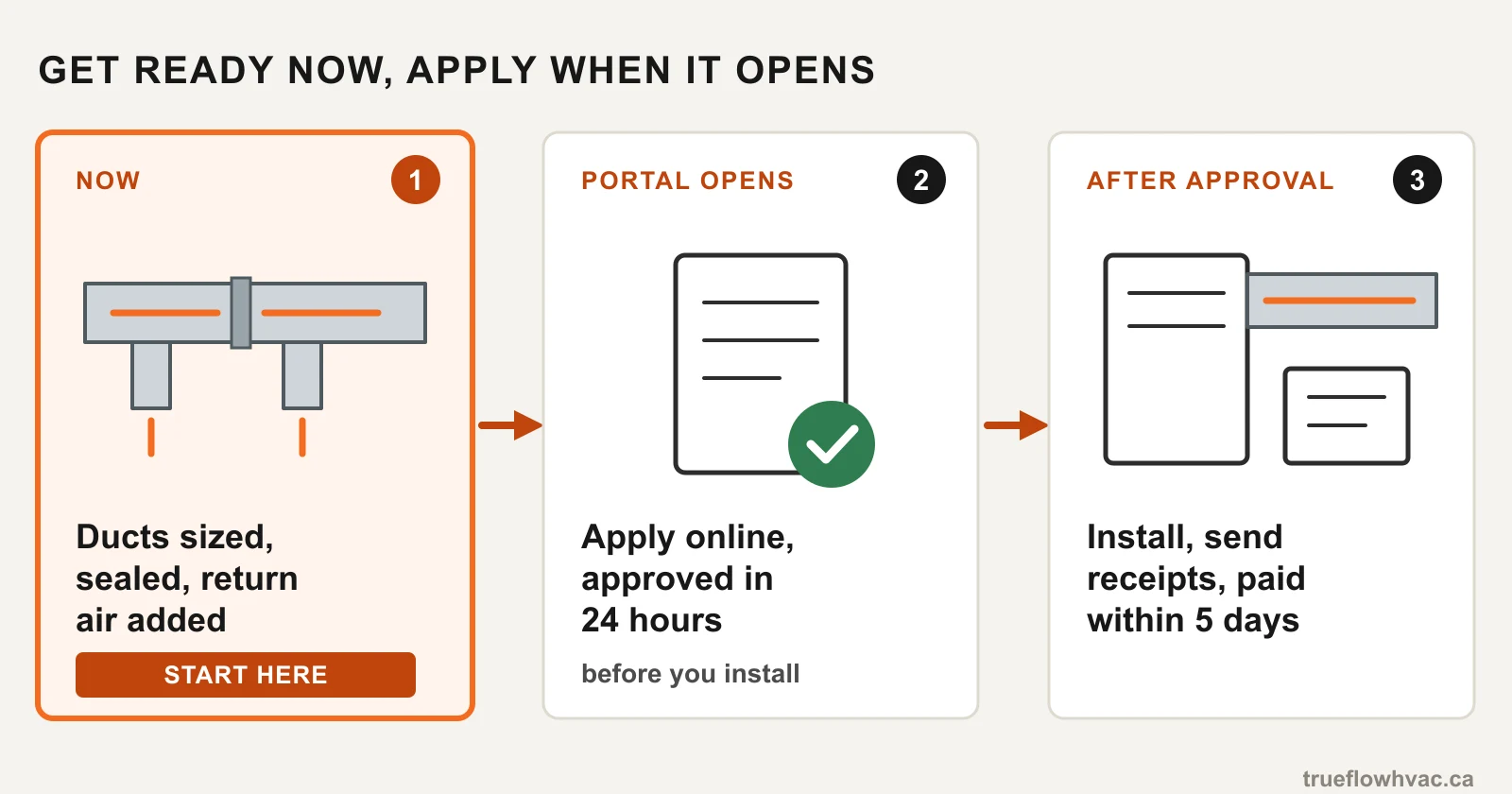
On 8 October 2026 the Prime Minister announced the National Heat Pump Rebate: up to $10,000 toward a heat pump, approved in 24 hours, no energy audits. It's the biggest new heat pump support Nova Scotians have seen since the Oil to Heat Pump Affordability Program closed here in July.
It also isn't open yet: the portal opens in early 2027. But the clock has started. The Government of Canada published the first rules on 1 November 2026, and a heat pump installed from that day can be claimed once the portal opens. Here's what the rules say, what they leave open, whether to wait, and the part almost nobody is talking about: getting your house ready so the install isn't held up by the ductwork.
What the rules say
The rebate is part of a $2 billion, eight-year federal plan to retrofit a million homes, aimed at up to 820,000 households (Prime Minister's Office; Government of Canada). These are the rules as the Government of Canada's program page set them out on 1 November 2026:
| What the government says | |
|---|---|
| Amount | $2,000, or up to $10,000 if your household income is at or below the limit below. "Actual rebate amounts will depend on household income and the cost of the equipment installed" |
| The equipment | Must be on the eligible product list, identified by its AHRI number |
| Who installs it | Your heat pump must be "purchased from and installed by a HVAC contractor." Equipment you bought yourself doesn't fit that wording |
| Whole-home | The rebate "supports the installation of eligible heat pump systems that can heat your entire home" |
| Who can claim | You live in Canada and own the home. It doesn't have to be your primary residence, so a rental you own can count |
| Limit | One rebate per household, even if you own more than one property. The October announcement on Canada.ca said one per person; the program page now says household |
| Previous funding | "Federal funding has not previously been provided for a heat pump at the address" |
| Current heating | Electricity (including electric furnaces and baseboards), natural gas, heating oil, propane, diesel, coal or wood |
| Your old system | Planned and emergency installs both count. You don't have to remove your existing system or show that it broke down |
| Energy audits | None, before or after |
| Installs that count | From 1 November 2026 |
| Opening and closing | Portal in early 2027, no exact date. Expected to close in March 2034 |
| Getting paid | No payments until the program launches and your application is approved. The October announcement promised approval within 24 hours and said payment would be approved within five days of receipts; the program page doesn't repeat those timelines |
| Other programs | The Prime Minister's Office says both levels "can be combined with existing provincial programs." The program page doesn't address it |
The income limits in Nova Scotia
To get the higher amount, your after-tax household income must be at or below this:
| Household size | Nova Scotia limit |
|---|---|
| 1 person | $38,831 |
| 2 persons | $80,300 |
| 3 persons | $103,071 |
| 4 persons | $125,843 |
| 5 persons or more | $131,835 |
The figure is not your gross pay. Take line 23600 of your 2025 tax return and subtract line 43500, then do the same for a spouse or common-law partner and add the two. You give your Social Insurance Number when you apply, and the government says it goes to the Canada Revenue Agency to verify your income.
What has to be on your receipt
You must submit receipts within 6 months, and they have to show:
- the name and address of the person applying
- the name of the company installing the heat pump
- the make, model and AHRI number of the equipment
- the number of heat pumps installed
- the total project cost, "including necessary directly related activities, such as ductwork and electrical upgrades"
Ask for this before the job, not after. A receipt that just says "heat pump installed" doesn't carry what the program asks for.
Watch for door-to-door sales
The government says salespeople are visiting and calling homes using misleading references to this rebate, and that it "NEVER goes door-to-door" and makes no marketing calls. Start the conversation yourself, with a company you chose.
What the rules leave open
The government says "program parameters and eligibility criteria are still being finalized and remain subject to change," and that eligibility will be assessed on the criteria in effect on the day your heat pump was installed. These points decide what the rebate is worth to a particular house, and they aren't settled:
- Whether ductwork raises your rebate. It has to appear on the receipt, but the amount is said to depend on "the cost of the equipment installed." Those two lines don't tell you whether a $2,000 or a $10,000 claim changes because of duct work.
- How the "up to $10,000" is worked out. No formula has been published.
- Whether one ductless head counts as heating your entire home. The list includes single-head models, and the rules also ask for a system sized to the whole home. They don't say how that's tested. If you're planning one head with baseboards doing the rest, get this answered first.
- Which earlier programs count as federal funding at the address. The rule names none. Greener Homes and Oil to Heat Pump Affordability were federal programs, so if either paid for a heat pump at your address, possibly under a previous owner, ask before you count on this rebate.
- What the six months runs from. The page says "within 6 months" and doesn't say from when. Installs since 1 November are waiting on a portal that doesn't open until 2027, so keep everything.
- Rented or leased heat pumps. They "may be eligible" once the program launches, with details to come.
- How it will run in Nova Scotia. Efficiency Nova Scotia said on 26 October that its website would be updated as information became available.
We'll update this page as the government does.
Should you wait?
It depends on what your heating is doing right now.
| Your situation | What we'd suggest |
|---|---|
| Your system works and you're planning a heat pump | There's no rebate reason to hold off any more. You can install and claim when the portal opens, or wait for it. The risk in going early is that payment isn't guaranteed until you're approved, so check the household rules and the model's AHRI number first, and get the house ready (below) |
| Your system is old and you're worried about this winter | Get it checked and the heat pump planned now, with a model you've confirmed is on the list, rather than starting from scratch in a cold snap |
| Your system fails this winter | Don't go without heat. Emergency installs are accepted, so check the model against the list if you can, keep every receipt, and apply when the portal opens |
| You heat with oil and your income is under the limit | The higher amount, up to $10,000, is open to you. The provincial Oil to Heat Pump program is closed, so this is likely your main route. See what's open in Nova Scotia today for the interim help |
| You heat with electric baseboards | You qualify on fuel. The harder question is the whole-home line above, and whether that means several heads or new ductwork in your house |
You can sign up for federal updates on the program page.
Ducted or ductless?
The October announcement described a cold-climate air-source heat pump. The published list holds about 180,000 models: roughly 164,000 cold-climate air-source and 16,000 ground-source, both ducted and ductless. So the first decision is the same one it always was, and it turns on the house, with the whole-home line above now part of the question:
- A house with forced-air ductwork (an oil or electric furnace) can usually take a ducted heat pump that heats every room through the ducts you already have, if those ducts can carry the air.
- A house with baseboards, hot-water rads or no ducts usually gets ductless heads in the main spaces, or new ductwork if the layout and budget suit it.
We go through that choice in detail in ducted vs ductless heat pumps in Halifax.
The part nobody is talking about: your ductwork
The rebate is built for speed: approved in a day, installed "as quickly as a furnace." For a ducted heat pump, that only works if the ductwork is ready, and in older Nova Scotia houses it often isn't.
A heat pump moves more air at a lower temperature than the oil furnace it replaces. Ducts sized for a furnace's short blasts of very hot air can be too small for it. The usual problems are:
| What we find | Why it matters for a heat pump | The usual fix |
|---|---|---|
| A trunk sized for a furnace | Not enough air reaches the far rooms, so they stay cold and the system works harder | Resize or rework the main trunk |
| Too little return air | The system starves for air: noisy, inefficient, hard on the equipment | Add return grilles, upsize the return trunk, give upper floors a path back |
| Leaky joints | Heated air escapes before it reaches a register | Seal the joints with mastic |
| A plenum that doesn't fit the new unit | The air handler and the existing trunk don't line up | A fabricated plenum and transition |
The rules now name ductwork, but only as something your receipt must show in the total project cost; they don't say it adds to the rebate. Plan as if it may not. More importantly, it's the part you can sort out now, while the program is still being set up, so it isn't what holds up your install. Our guides on whether you need new ductwork for a heat pump, sizing ducts for a ducted heat pump and the oil-furnace conversion explain what that work involves.
How to get ready: a checklist
| When | What to do |
|---|---|
| Now | Sign up for federal updates. Gather your last year of heating bills or oil receipts. Have the house assessed: what heats it, what the ductwork can carry, what the electrical panel can take |
| Now, if ducted | Get the ductwork checked and any resizing, return air or sealing scoped, so it's ready before the heat pump arrives |
| Before you sign | Work out your after-tax income against the table above. Get the AHRI number from your contractor and look it up on the eligible product list. Ask whether federal money has ever paid for a heat pump at your address |
| If you install before the portal opens | Make sure the receipt shows everything listed above, keep it, and apply once the portal launches in early 2027 |
| If you wait for the portal | Apply, get approved (the October announcement promised within 24 hours), then book the install. With the ducts and the plan already settled, it can go ahead right away |
| After installation | Submit your receipts through the portal. Keep copies of everything |
Where we fit in
We install heat pumps, ducted and ductless, and do the ductwork they depend on, as one job with one point of contact. The refrigerant work is done by certified refrigeration technicians, as Nova Scotia requires. Because ductwork is our trade, we look at the whole system, not just the box: a heat pump on ducts that can't carry the air is the most common reason a conversion disappoints.
We don't quote prices before we've seen the house, and we don't administer the rebate. What we can do now is plan the job with you, so that when the portal opens you're applying with a project ready to go.
Sources
This page makes no cost claims about our work. Program details are taken from the primary government documents below and were verified on 2 November 2026. All amounts are Canadian dollars, and every source is Canadian.
- Prime Minister's Office: Prime Minister Carney announces landmark investment to retrofit one million homes, 8 October 2026. Source of the program name, the $10,000 / $2,000 amounts, up to 820,000 households, the online portal, approval within 24 hours, no audits, and combining with provincial programs.
- Government of Canada (Environment and Climate Change Canada): the announcement on Canada.ca (eligible electric cold-climate air-source heat pumps, one rebate per person, since replaced by one per household, approval within 24 hours, receipts after installation, payment approved within five days, and the breakdown framing); the backgrounder ($2 billion over eight years); and the National Heat Pump Rebate program page (modified 1 November 2026: the source for the eligibility rules, the Nova Scotia income limits, the receipt requirements, the opening and closing dates, the fuels, and the scam warning).
- Natural Resources Canada: the searchable eligible product list for this program (179,620 models when we read it on 2 November 2026: 163,692 cold-climate air-source and 15,928 ground-source).
- Canadian Press, via CP24, 8 October 2026: the first report of the early 2027 launch target, attributed to unnamed officials and since confirmed on the Government of Canada's own page. We no longer rely on it for anything the government has published.
- Efficiency Nova Scotia: Heat pump rebates ("our website will be updated as information becomes available," checked 26 October 2026; we could not read the page's text when we rechecked on 2 November, so this line may be out of date).
What we could not confirm
- The exact opening date, the rebate formula, Nova Scotia delivery, and whether ductwork or electrical work changes the rebate amount. The 1 November page doesn't settle any of them, and it says the criteria are still being finalized.
- Whether a single ductless head meets the whole-home line, or what the six-month receipt window runs from. The page doesn't say, and we would rather tell you that than guess.
- That Greener Homes or Oil to Heat Pump Affordability money counts under the previous-funding rule. Both were federal programs, but the rule names no program; that reading is ours.
- The heat pump's airflow needs. The point that a heat pump moves more air at a lower temperature than a furnace is explained, with its sources, in our duct sizing guide; this page doesn't add new figures to it.
Related services
Frequently asked questions
When does the National Heat Pump Rebate open?
The Government of Canada says the online portal opens in early 2027 and is expected to close in March 2034; no exact opening date has been published. Installs do not have to wait for it: households that meet the criteria and install an eligible heat pump from 1 November 2026 may be eligible to apply once it opens. No payments are made until then, and funding is not guaranteed until an application is approved.
How much is the National Heat Pump Rebate, and what are the income limits in Nova Scotia?
Up to 10,000 dollars if your after-tax household income is at or below the limit for your household size, and 2,000 dollars otherwise. The amount also depends on the cost of the equipment. The Nova Scotia limits are 38,831 dollars for one person, 80,300 for two, 103,071 for three, 125,843 for four and 131,835 for five or more. To work out your figure, take line 23600 of your 2025 tax return and subtract line 43500, then do the same for a spouse or common-law partner and add the two.
Should I wait for the rebate before replacing my heating system?
You no longer have to. An eligible heat pump installed from 1 November 2026 can be claimed once the portal opens in early 2027, and both planned and emergency installations are accepted. Before you buy, check the model's AHRI number on the federal list and make sure a contractor is supplying and installing it, because claiming later only works if the household and the system qualify. The government says the criteria are still being finalized, and that eligibility is assessed on the criteria in effect on the day the heat pump was installed. If your system fails, don't go without heat.
Does the National Heat Pump Rebate cover ductwork?
The rules stop short of saying so. The receipt must show the total project cost, including necessary directly related activities such as ductwork and electrical upgrades, but the government also says the rebate amount depends on household income and the cost of the equipment installed. So plan as if the ductwork a ducted heat pump needs may not raise your rebate, have it shown on the contractor's receipt anyway, and get it assessed early so it doesn't hold up the installation.
Does the rebate cover ducted or ductless heat pumps?
The federal product list carries both kinds of system: it lists about 180,000 models by AHRI number, mostly cold-climate air-source units. But the government also says the rebate supports systems that can heat your entire home, and encourages you to confirm with your contractor that the system is sized to do that. It does not say whether a single ductless head in a house with other rooms on baseboard would pass, so settle that before you count on the rebate.
Do I need an energy audit for the National Heat Pump Rebate?
No. The Government of Canada says no energy audits are required before or after installation. That's different from Efficiency Nova Scotia's own rebates, where a Home Energy Assessment comes first. If you plan to combine the federal rebate with a provincial program, check that program's rules, because its steps still apply to it.
Questions about your own home?
Tell us what's happening and we'll give you a straight answer and a practical quote.
Request a Quote