Modern Heat for a Century Halifax Home: Keeping the Character, Losing the Oil
A century Halifax home can move off oil to modern heating and cooling without losing its character. The three concealed paths are: a small-duct high-velocity (SDHV) system, whose 2-inch supply tubes route through existing wall cavities and closets and end in small, discreet outlets; compact conventional ducting run through basements, closets, and reused pipe chases; or an air-to-water heat pump that keeps the original radiators (least disruption, but no cooling, and the rads must be verified for lower water temperatures). All three pair with cold-climate heat pumps rated well below minus 25 Celsius. Beyond comfort, the switch is one of the largest carbon cuts a Nova Scotia homeowner can make: the federal Oil to Heat Pump Affordability program reports an average reduction of about 2.8 tonnes of CO2 per year for every home converted, measured across a program in which Nova Scotia had more participating households than any other province.
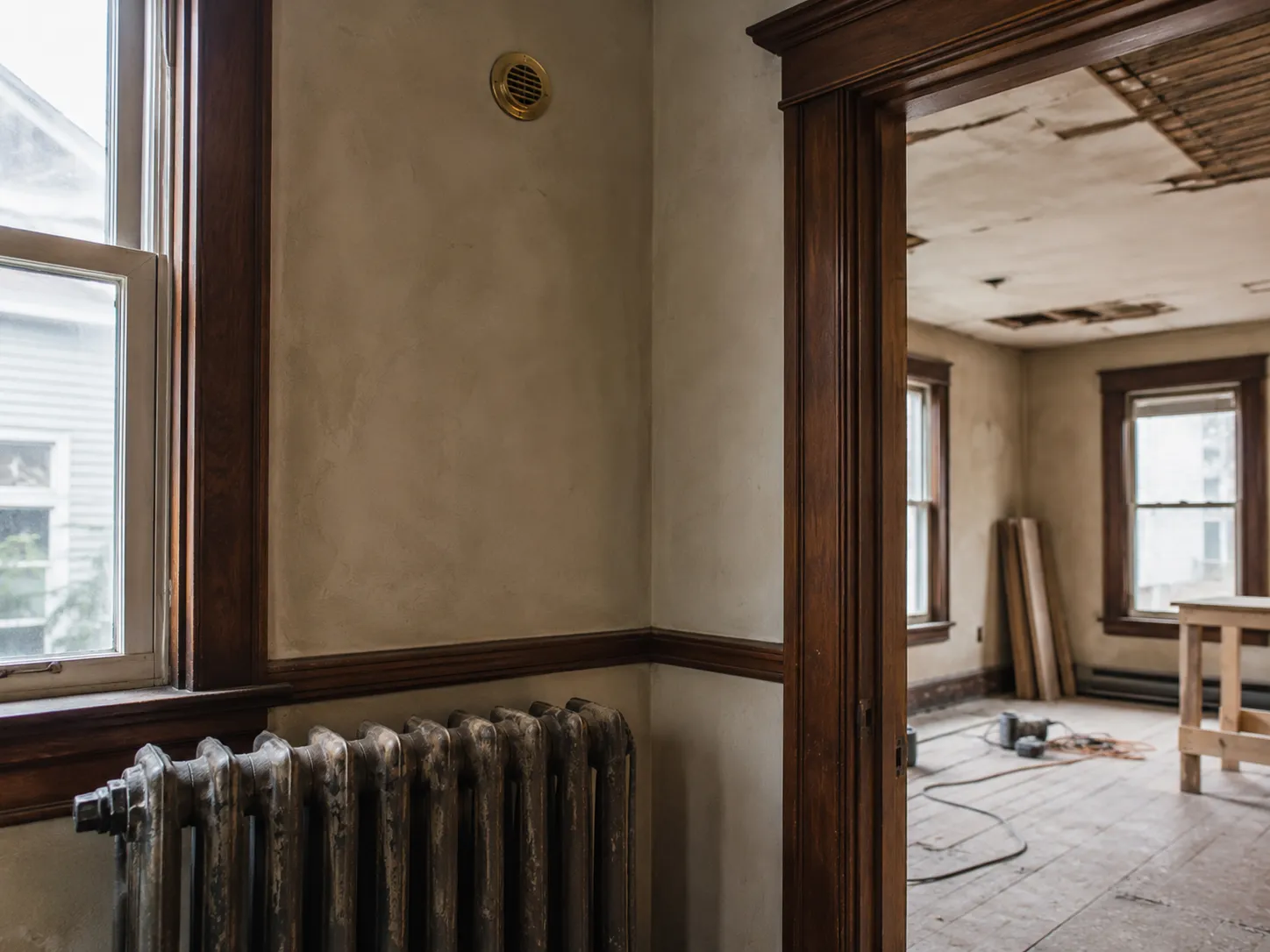
Walk the South End or the North End and you can read the problem from the sidewalk: beautiful century homes, original trim, plaster walls — and an oil tank at the side of the house. Owners of these homes tend to love them exactly as they are, which is why so many are still burning oil years after they wanted out. The assumption is that modern heating means wrecking the interiors: ductwork through plaster, wall units in the living room, bulkheads across century ceilings.
That assumption is out of date. A century home can have modern, efficient heating and cooling with nothing visible but a few small outlets — and getting there is one of the biggest environmental upgrades a Nova Scotia homeowner can make.
Why these homes are genuinely harder (and why that's fine)
Century Halifax homes weren't built for ducted air. Most run on hot-water radiators or electric baseboard, and the construction works against casual retrofits:
- Plaster and lath is dense, brittle, and hard to patch invisibly. Cutting big openings for conventional duct is exactly the damage owners fear.
- No utility chases. These houses predate the idea of leaving room for services, so every route has to be found or made.
- Solid framing quirks — true-dimension lumber, fire blocking in unexpected places, and floors that don't line up with modern assumptions.
But the same era of construction often hides advantages, if you know what's behind the plaster. Some of these homes are balloon-framed, with stud cavities running full height from sill to attic — natural routing paths. Others, especially the older Maritime stock, are plank-framed: near-solid board walls with little cavity at all, where the routing lives instead in closet corners, pantry backs, stacked floor systems, and the chases the old radiator pipes already occupy. Which construction you have changes the plan completely, and it's one of the first things we establish on a walkthrough. Either way, it's a craft problem, not a demolition problem.
The three concealed paths off oil
1. Small-duct high-velocity (SDHV). The system built for exactly this house. Supply runs are roughly 2-inch insulated flexible tubes that snake through stud cavities and closets the way wiring does, ending in small, discreet outlets instead of big registers. Paired with a cold-climate heat pump, it heats, cools, and dehumidifies the whole home with almost nothing visible. If ductless wall heads are what you're trying to avoid, this is the system to understand — we break it down fully in our small-duct high-velocity guide.
2. Compact conventional ducting. Where a home has generous basements, stacked closets, or reusable chases, a carefully designed conventional ducted heat pump can be run with minimal intrusion — trunk lines in the basement ceiling, risers hidden in closets, custom-fabricated transitions where stock parts won't fit. It costs less than SDHV where the paths exist. The mechanics of that kind of conversion are covered in our guide on what happens to ductwork in an oil-to-heat-pump conversion.
3. Keep the radiators: an air-to-water heat pump. The lowest-disruption path swaps the oil boiler for a heat pump that heats water, feeding the radiators you already have — and cast-iron rads are themselves part of many heritage interiors. The honest caveats: no cooling or dehumidification, and radiators sized for high-temperature oil water have to be verified for heat-pump water temperatures rather than assumed. For owners who want summer comfort, this path usually loses to the first two.
All three pair with cold-climate equipment rated well below minus 25 Celsius, so a full oil exit is realistic in a Halifax winter.
The character question, answered room by room
What each path means for your interiors is usually the deciding factor:
- SDHV: small outlets, roughly the size of a pot light or a smoke-detector plate, placed in ceilings, floors, or high on walls. No registers, no soffits, no wall units. Plaster stays intact except at the outlet points and limited access openings.
- Compact ducted: normal registers, but routed so the duct lives in the basement, closets, and chases. Done well, the visible change is registers where you agree to put them.
- Air-to-water: the house looks exactly as it does today. The change is in the basement.
Whichever path you choose, the work in a heritage home should include closing and finishing what gets opened. That's how we quote it: routing planned to spare the plaster, penetrations closed properly, and repairs handled as part of the job rather than left behind.
The environmental case, in real numbers
The character conversation is why people hesitate; the environmental one is why the switch matters beyond your own bills.
The best evidence here isn't a projection — it's measured, and it's from this province. Nova Scotia had 14,950 households in the federal Oil to Heat Pump Affordability program, more than any other province, so the reported averages describe homes like yours:
- About 2.8 tonnes of CO2 per year, per home. That's the Government of Canada's reported average for every home converted under the program — "on average, 2.8 tonnes per year of pollution will be reduced for every home that receives an OHPA grant." For one house, that is a large number.
- About $1,337 a year off the energy bill — again the program's own measured average, not a sales projection. You will see wider ranges quoted elsewhere; treat them with care. Your own saving depends on the size of the house, how much oil you burn, and what oil and power cost that year, so it can land well above or below the average.
- The math improves every year you own it. Nova Scotia has legislated it: the Environmental Goals and Climate Change Reduction Act commits the province "to have 80% of electricity in the Province supplied by renewable energy by 2030" and "to phase out coal-fired electricity generation in the Province by the year 2030." As the grid gets cleaner, the same heat pump's footprint shrinks with it. An oil furnace only ever gets older.
For a century home, there's something fitting in the preservationists' old line that the greenest building is the one already standing. Converting it off oil keeps a hundred years of embodied character and craftsmanship in service, instead of treating heritage and climate as competing goals.
Where we fit in
The hard part of a heritage conversion isn't the heat pump — it's getting the distribution through a century of plaster and framing without leaving scars. That's sheet-metal and ductwork craft, and it's our trade. We assess the house, tell you honestly which of the three paths fits (including when the cheapest one is the right one), design and fabricate the routing to spare the interiors, and coordinate the rest of the job so you deal with one team. Our Halifax page covers how we work across the peninsula's older stock. If you're staring at an oil tank and a house you love, send us a photo of both — that's enough to start.
Sources
Figures on this page are in Canadian dollars and were last verified on August 16, 2026. The conversion savings quoted are reported program averages, not a quote or a prediction for your house — what you actually save depends on the size of the home, how much oil you burn, and what oil and electricity cost that year.
- Government of Canada / Natural Resources Canada — The Oil to Heat Pump Affordability Program, source of the measured per-household averages (about 2.8 tonnes of CO2 and $1,337 a year) and the Nova Scotia participation figure.
- Province of Nova Scotia — the Environmental Goals and Climate Change Reduction Act, which legislates the 80%-renewable-by-2030 and coal-phase-out commitments quoted above.
Related services
Frequently asked questions
How do you heat a 100-year-old house efficiently?
With a cold-climate heat pump matched to distribution that suits the house. In a century home that usually means one of three concealed approaches: a small-duct high-velocity system routed through existing wall cavities, compact conventional ducting through basements and closets, or an air-to-water heat pump feeding the original radiators. Modern cold-climate units heat reliably well below minus 25 Celsius and are two to three times more efficient than an oil furnace or boiler, which is where the running-cost savings come from.
Can you install ductwork in an old house with plaster walls without wrecking it?
Yes, if the system is chosen to fit the house rather than the other way around. Plaster and lath is brittle and hard to patch invisibly, so full-size rectangular duct usually means soffits or opened walls. The workarounds are small-duct high-velocity tubing, which snakes through stud cavities and closet corners the way wiring does, and careful compact ducting through basements, closets, and the chases the old radiator pipes already use. Century Halifax homes split between balloon framing, whose full-height stud cavities make surprisingly good routing paths, and older plank-framed walls with almost no cavity, where closets, pantries, and the old pipe chases do the work instead — knowing which you have is step one.
Should I keep my radiators or remove them?
It depends on what you want from the system. Keeping the rads and swapping the oil boiler for an air-to-water heat pump means the least disruption, and cast-iron radiators are part of many heritage interiors. But radiators sized for high-temperature oil water don't always deliver enough heat at heat-pump water temperatures, and rads can never give you cooling or dehumidification. If summer comfort is part of the goal, a ducted path usually wins. We'd assess rather than assume.
Do heat pumps actually work in old, draftier homes?
Yes, when they're sized honestly. An older home has a bigger heat load than a new one, so the heat-loss calculation matters more, not less — an undersized system disappoints regardless of age. Cold-climate units rated below minus 25 Celsius handle Nova Scotia winters, and pairing the conversion with basic air-sealing (often easy while walls or chases are open) shrinks both the load and the bills.
How much difference does getting off oil make for the environment?
More than almost anything else you can do to a house here, and the figure is measured rather than projected. The federal Oil to Heat Pump Affordability program reports an average reduction of about 2.8 tonnes of CO2 per year for every home converted, and Nova Scotia had 14,950 households in it — more than any other province — so that average describes homes like ours. The reported average energy-bill saving is about $1,337 a year, though your own depends on the size of the house and what oil and power cost. And because Nova Scotia has legislated 80% renewable electricity and a coal phase-out by 2030, the same heat pump gets cleaner every year it runs.
What does it cost to convert a century home off oil?
It depends on the path and the house, and any number given before a walkthrough is a guess. The honest drivers are the heat-loss calculation that sets capacity, which distribution approach fits your framing, how much routing has to be fabricated, and whether the boiler also heats your domestic hot water. A concealed conversion in a century home is a significant project, typically at or above the cost of a standard furnace conversion. What we can do is assess the house and give you a firm, itemized picture — including honest advice if part of the answer is that you don't need something.
Questions about your own home?
Tell us what's happening and we'll give you a straight answer and a practical quote.
Request a Quote